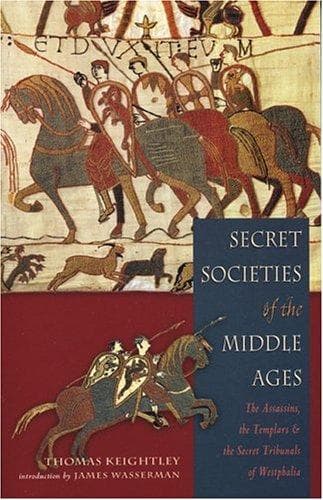
Secret Societies of the Middle AgesKeightley, Thomas
History
Secret Societies of the Middle Ages
Keightley, Thomas
Secret societies
The followers of Hassan Sabah were called the Eastern Ismaïlites, to
distinguish them from those of Africa. They were also named the
Batiniyeh (_Internal or Secret_), from the secret meaning which they
drew from the text of the Koran, and Moolhad, or Moolahid (_Impious_) on
account of the imputed impiety of their doctrines,--names common to them
with most of the preceding sects. It is under this last appellation that
they were known to Marco Polo, the Venetian traveller. The name,
however, by which they are best known in Europe, and which we shall
henceforth chiefly employ, is that of Assassins. This name is very
generally derived from that of the founder of their society; but M. De
Sacy has made it probable that the oriental term Hashisheen, of which
the Crusaders made Assassins, comes from Hashish, a species of hemp,
from which intoxicating opiates were made, which the Fedavee were in the
habit of taking previously to engaging in their daring enterprises, or
employed as a medium of procuring delicious visions of the paradise
promised to them by the Sheikh-al-Jebal.
It is a curious question how Hassan Sabah contrived to infuse into the
Fedavee the recklessness of life, joined with the spirit of implicit
obedience to the commands of their superiors, which they so invariably
displayed. We are told[33] that the system adopted for this purpose was
to obtain, by purchase or otherwise, from their parents, stout and
healthy children. These were reared up in implicit obedience to the will
of the Sheikh, and, to fit them for their future office, carefully
instructed in various languages. The most agreeable spots were selected
for their abode, they were indulged in the gratification of their
senses, and, in the midst of their enjoyments, some persons were
directed to inflame their imaginations by glowing descriptions of the
far superior delights laid up in the celestial paradise for those who
should be admitted to repose in its bowers; a happiness only to be
attained by a glorious death met in obedience to the commands of the
Sheikh. When such ideas had been impressed on their minds, the glorious
visions ever floated before their eyes, the impression was kept up by
the use of the opiate above-mentioned, and the young enthusiast panted
for the hour when death, obtained in obeying the order of the Sheikh,
should open to him the gates of paradise to admit him to the enjoyment
of bliss never to end.
[Footnote 33: Wilken, Geschichte der Kreuzzüge, vol. ii.]
The celebrated Venetian, Marco Polo, who traversed the most remote parts
of the East in the 13th century, gave on his return to Europe an account
of the regions which he had visited, which filled the minds of men with
wonder and amazement. As is usual in such cases this was followed or
accompanied by unbelief, and it is only by the inquiries and discoveries
of modern travellers that the veracity of Marco Polo, like that of
Herodotus, has been established and placed beyond doubt.
Public-domain text, read in full here on John Shaqi.
Reviews
Reviews
No reviews yet
Be the first to share your thoughts on this work.
Elsewhere in the archive
Join the Discussion
Join the discussion
Sign in to leave a comment or review.
Sign InorCreate an account