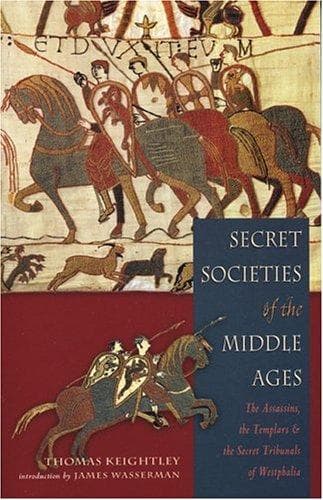
Secret Societies of the Middle AgesKeightley, Thomas
History
Secret Societies of the Middle Ages
Keightley, Thomas
Secret societies
We must again express our opinion that the minute accounts which are
given to us by some writers, respecting the rules and doctrines of
secret associations, should be received with a considerable degree of
hesitation, owing to the character and the means of information of those
from whom we receive them. In the present case our authority is a very
suspicious one. We are told that when Alamoot was taken by Hoolekoo
Khan, the Mongol prince, he gave his vizir, the learned Ata-Melek
(_King's father_) Jowani, permission to examine the library, and to
select such books as were worthy of being preserved. The vizir took out
the Korans and some other books of value in his eyes; the rest, among
which are said to have been the archives and the secret rules and
doctrines of the society, he committed, after looking cursorily through
them, to the flames. In an historical work of his own he gave the result
of his discoveries in those books, and he is the authority from which
Mirkhond and other writers have derived the accounts which they have
transmitted to us. It is quite clear, therefore, that the vizir of
Hoolakoo was at liberty to invent what atrocities he pleased of the sect
which was destroyed by his master, and that his testimony is
consequently to be received with suspicion. On the other hand it
receives some confirmation from its agreement with the account of the
society at Cairo given by Macrisi, and is not repugnant to the spirit of
Soofeïsm.
This last doctrine, which is a kind of mystic Pantheism, viewing God in
all and all in God, may produce, like fatalism, piety or its opposite.
In the eyes of one who thus views God, all the distinctions between vice
and virtue become fleeting and uncertain, and crime may gradually lose
its atrocity, and be regarded as only a mean for the production of a
good end. That the Ismaïlite Fedavee murdered innocent persons without
compunction, when ordered so to do by his superiors, is an undoubted
fact, and there is no absurdity in supposing that he and they may have
thought that in so doing they were acting right, and promoting the cause
of truth. Such sanctifying of crime is not confined to the East; the
maxim that the end sanctions the means is of too convenient a nature not
to have prevailed in all parts of the world; and the assassins of Henry
III. and Henry IV. of France displayed all the sincerity and constancy
of the Ismaïlite Fedavees. Without, therefore, regarding the heads of
the Ismaïlites, with Hammer, mere ruthless and impious murderers, who
trampled under foot religion and morals with all their obligations, we
may assent to the opinion of their leading doctrine being Soofeïsm
carried to its worst consequences.
Public-domain text, read in full here on John Shaqi.
Reviews
Reviews
No reviews yet
Be the first to share your thoughts on this work.
Elsewhere in the archive
Join the Discussion
Join the discussion
Sign in to leave a comment or review.
Sign InorCreate an account