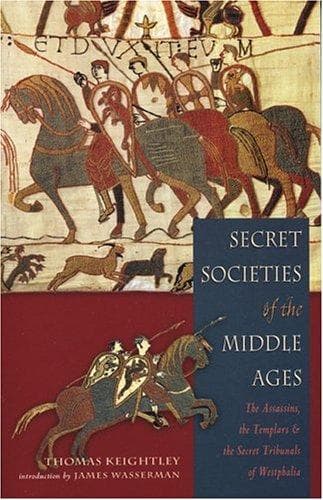
Secret Societies of the Middle AgesKeightley, Thomas
History
Secret Societies of the Middle Ages
Keightley, Thomas
Secret societies
"Our narrative now returns to Ismaïl the chief of the Ismaïlites. He
took with him his people laden with gold, silver, pearls, and other
effects, taken away from the inhabitants of the coasts, and which he had
received in the island of Cyprus, and on the part of the king of Egypt,
Dhaher, the son of Hakem-biëmr-Illah. Having bidden farewell to the
sultan of Egypt at Tripolis, they proceeded to Massyat, when the
inhabitants of the castles and fortresses assembled to enjoy themselves,
along with the chief Ismail and his people. They put on the rich dresses
with which the sultan had supplied them, and adorned the castle of
Massyat with everything that was good and fine. Ismaïl made his entry
into Massyat with the Devoted (_Fedavee_), as no one has ever done at
Massyat before him or after him. He stopped there some time to take into
his service some more persons whom he might make Devoted both in heart
and body.
"With this view he had caused to be made a vast garden, into which he
had water conducted. In the middle of this garden he built a kiosk
raised to the height of four stories. On each of the four sides were
richly-ornamented windows joined by four arches, in which were painted
stars of gold and silver. He put into it roses, porcelain, glasses, and
drinking-vessels of gold and silver. He had with him Mamlooks (_i. e._
slaves), ten males and ten females, who were come with him from the
region of the Nile, and who had scarcely attained the age of puberty. He
clothed them in silks and in the finest stuffs, and he gave unto them
bracelets of gold and of silver. The columns were overlaid with musk and
with amber, and in the four arches of the windows he set four caskets,
in which was the purest musk. The columns were polished, and this place
was the retreat of the slaves. He divided the garden into four parts. In
the first of these were pear-trees, apple-trees, vines, cherries,
mulberries, plums, and other kinds of fruit-trees. In the second were
oranges, lemons, olives, pomegranates, and other fruits. In the third
were cucumbers, melons, leguminous plants, &c. In the fourth were roses,
jessamine, tamarinds, narcissi, violets, lilies, anemonies, &c. &c.
Public-domain text, read in full here on John Shaqi.
Reviews
Reviews
No reviews yet
Be the first to share your thoughts on this work.
Elsewhere in the archive
Join the Discussion
Join the discussion
Sign in to leave a comment or review.
Sign InorCreate an account