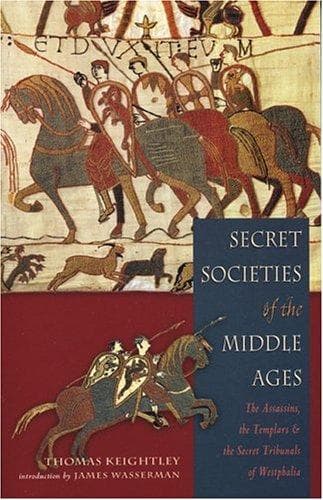
Secret Societies of the Middle AgesKeightley, Thomas
History
Secret Societies of the Middle Ages
Keightley, Thomas
Secret societies
The preceding accounts, whatever may be thought of their truth, serve to
testify a general belief throughout the East of some extraordinary means
being employed by the mountain chief to acquire the power which he was
known to possess over the minds of his Fedavee. And, in fact, there is
no great improbability in the supposition of some artifice of that
nature having been occasionally employed by him; for, when we recollect
that an Asiatic imagination is coarse, especially among the lower
orders, and that in the East men rarely see any females but those of
their own family, the chief might find no great difficulty in persuading
a youth, whom he had transported in a state of stupor into an apartment
filled with young girls, of his having been in the actual paradise
promised to the faithful.
But, laying aside supposition, we may observe that the very power over
the minds of their followers ascribed to Hassan Sabah and his successors
has been actually exercised in our own days by the chief of the
Wahabees. Sir John Malcolm[38] informs us, from a Persian manuscript,
that a few years ago one of that sect, who had stabbed an Arab chief
near Bussora, when taken, not only refused to do anything towards saving
his life, but, on the contrary, seemed anxiously to court death. He was
observed to grasp something firmly in his hand, which he appeared to
prize beyond life itself. On its being taken from him and examined, it
proved to be an order from the Wahabee chief for an emerald palace and a
number of beautiful female slaves in the blissful paradise of the
Prophet. This story, however, it must be confessed, appears to be little
consistent with the principles of the sect of the Wahabees, and we may
suspect that it has originated in some misapprehension.
[Footnote 38: History of Persia, vol. i.]
The following instance of the implicit obedience of the Fedavee to the
orders of Hassan Sabah is given by a respectable oriental historian[39].
An ambassador from the Sultan Malek Shah having come to Alamoot to
demand the submission and obedience of the sheikh, Hassan received him
in a hall in which he had assembled several of his followers. Making a
sign to one youth, he said, "Kill thyself!" Instantly the young man's
dagger was plunged into his own bosom, and he lay a corpse upon the
ground. To another he said, "Fling thyself down from the wall." In an
instant his shattered limbs were lying in the castle ditch. Then turning
to the terrified envoy, "I have seventy thousand followers who obey me
after this fashion. This be my answer to thy master."
[Footnote 39: Elmacin, Historia Saracenica, l. iii. p. 286.]
Public-domain text, read in full here on John Shaqi.
Reviews
Reviews
No reviews yet
Be the first to share your thoughts on this work.
Elsewhere in the archive
Join the Discussion
Join the discussion
Sign in to leave a comment or review.
Sign InorCreate an account