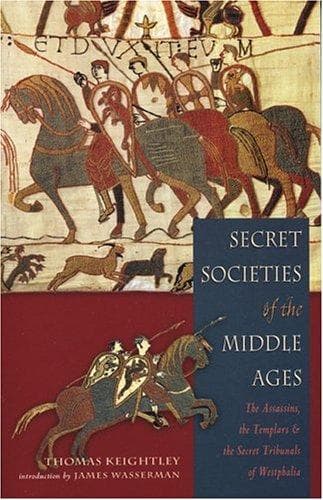
Secret Societies of the Middle AgesKeightley, Thomas
History
Secret Societies of the Middle Ages
Keightley, Thomas
Secret societies
The ill leaven of the secret doctrine displayed itself before very long.
Keäh Mohammed, who appears to have been a weak, inefficient man, was
held in little esteem by his followers. They began to attach themselves
to his son Hassan, who had the reputation of being a man of prodigious
knowledge, learned in tradition and the text of the Koran, versed in
exposition, and well acquainted with the sciences. Hassan, either
through vanity or policy, began secretly to disseminate the notion of
his being himself the imam whose appearance had been promised by Hassan
Ben Sabah. Filled with this idea, the more instructed members of the
society vied with each other in eagerness to fulfil his commands, and
Keäh Mohammed, seeing his power gradually slipping from him, was at
length roused to energy. Assembling the people, he reprobated in strong
terms the prevailing heresy. "Hassan," said he, "is my son, and I am not
the imam, but only one of his missionaries. Whoever maintains the
contrary is an infidel." Then, in true Assassin fashion, he gave effect
to his words by executing 250 of his son's adherents, and banishing an
equal number from the fortress. Hassan himself, in order to save his
life, was obliged publicly to curse those who held the new opinions, and
to write dissertations condemning their tenets, and defending those of
his father. By these means he succeeded in removing suspicion from the
mind of the old chief; but, as he continued to drink wine in private,
and violated several of the other positive precepts of the law, his
adherents became only the more convinced of his being the imam, at whose
coming all the precepts of the law were to cease to be of any force.
Hassan was obliged to be cautious and conceal his opinions during the
lifetime of his father; for, whatever their opinion might be of the
capacity and intellectual power of the head of their sect, the Assassins
believed themselves to be bound to obey his orders, as proceeding from
the visible representative of the sacred invisible imam; and, high as
their veneration for Hassan was, his blood would have flowed on the
ground the instant an order to that effect had passed the lips of his
father. But no sooner was Keäh Mohammed dead, after a reign of
twenty-four years, and the supreme station was come to Hassan himself,
than he resolved to fling away the mask at once, and not only to trample
on the law himself, but to authorize and encourage all his people to do
the same.
Accordingly, when the month Ramazan (the Mohammedan Lent) of the 559th
year of the Hejra (A.D. 1163) was come, he ordered all the inhabitants
of Roodbar to assemble on the place of prayer (_Mosella_), or esplanade,
before the castle of Alamoot. Facing the direction of the Keblah[46] he
caused a pulpit to be erected, at whose four corners were displayed
banners of the different hues familiar to Islam, namely, a white, a red,
a yellow, a green, colours adverse to the black of the Abbassides.
Public-domain text, read in full here on John Shaqi.
Reviews
Reviews
No reviews yet
Be the first to share your thoughts on this work.
Elsewhere in the archive
Join the Discussion
Join the discussion
Sign in to leave a comment or review.
Sign InorCreate an account