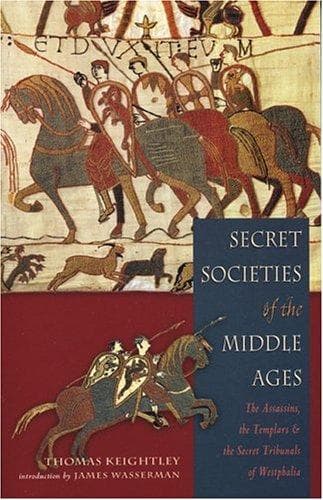
Secret Societies of the Middle AgesKeightley, Thomas
History
Secret Societies of the Middle Ages
Keightley, Thomas
Secret societies
Degeneracy is the inevitable lot of unlimited power. The Fatimite
Commanders of the Faithful were now become mere puppets in the hands of
their ministers, and the post of vizir was now, as was so often the case
with the throne, contended for with arms. A civil war was at this time
raging in Egypt between Shaver and Dhargam, rival candidates for the
viziriate. The former came in person to Damascus, and offered the atabeg
Noor-ed-deen a third of the revenues of Egypt if he would aid him to
overcome his rival. Without hesitation Noor-ed-deen ordered Asad-ed-deen
(_Lion of Religion_) Sheerkoh (_Mountain Lion_)[47], a Koordish chief
who commanded for him at Emessa, to assemble an army and march for
Egypt. Sheerkoh obeyed, and sorely against his will, and only at the
urgent command of Noor-ed-deen, did his nephew, the then little known,
afterwards so justly famous, Saladin, quit the banquets and enjoyments
of Damascus, and the other towns of Syria, to accompany his uncle to the
toils and the perils of war. Dhargam was victorious in the first action,
but he being murdered shortly afterwards by one of his slaves, Shaver
obtained possession of the dignity which he sought. The new vizir then
tried to get rid of his allies, but such was not the intention of
Noor-ed-deen, and Sheerkoh took his post with his troops in the
north-eastern part of the kingdom, where he occupied the frontier town
of Belbeïs, on the most eastern branch of the Nile, under pretext of
receiving the third part of the revenue which had been promised to
Noor-ed-deen. Shaver, anxious to get rid of such dangerous guests,
formed a secret league with Amalric, King of Jerusalem, and engaged to
give him 60,000 ducats for his aid against them. Sheerkoh, who had been
reinforced, advanced into Upper Egypt, and Saladin took the command of
Alexandria, which he gallantly defended for three months against the
combined forces of the Christians and Egyptians, and, after some
fighting, peace was made on condition of Noor-ed-deen receiving 50,000
ducats, and double that sum being paid annually to the King of
Jerusalem.
[Footnote 47: The former of these names is Arabic, the latter Persian.]
Public-domain text, read in full here on John Shaqi.
Reviews
Reviews
No reviews yet
Be the first to share your thoughts on this work.
Elsewhere in the archive
Join the Discussion
Join the discussion
Sign in to leave a comment or review.
Sign InorCreate an account