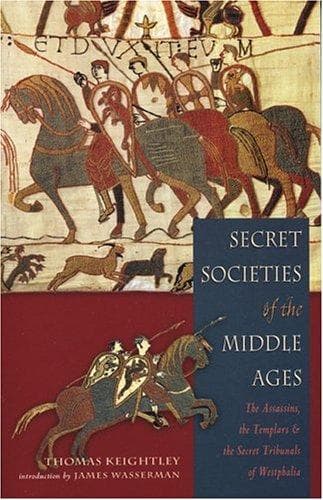
Secret Societies of the Middle AgesKeightley, Thomas
History
Secret Societies of the Middle Ages
Keightley, Thomas
Secret societies
The neglect of chronology by the oriental historians, or their European
translators and followers, is frequently such that we are left in great
uncertainty as to the exact time of particular events, and are thus
unable to trace them to their real causes and occasions. The mention of
the earthquake of 1157 would however seem to make it probable that it
was about that time that Sinan put forward his claims to divinity; and
as, at that very period, Hassan, the son of Keäh Mohammed, was giving
himself out for the promised imam, we may suppose that it was his
example which stimulated Sinan to his bold attempt at obtaining
independent dominion over the Syrian branch of the Ismaïlites.
Sinan was, like Hassan, a man of considerable learning. His works are
held in high estimation by the remains of the sect of the Ismaïlites
still lingering among the mountains of Syria. These works, we are told,
consist of a chaotic mixture of mutilated passages of the Gospel and the
Koran, of contradictory articles of belief, of hymns, prayers, sermons,
and regulations, which are unintelligible even to those who receive and
venerate them.
The sacred books of the Christians formed, as we see, a part of the
studies of the Sheikh of Massyat, and, as it would appear, he thought he
might derive some advantage from his acquaintance with them. The
religio-military society of the Knights of the Temple, whose history we
shall soon have to record, had possessions in the neighbourhood of those
of the Assassins, and their superior power had enabled them, at what
time is uncertain, to render the latter tributary. The tribute was the
annual sum of 2,000 ducats, and Sinan, to whom probably all religions
were alike, and who had unbounded power over the minds of his people,
conceived the idea of releasing himself from it by professing the same
religion with his neighbours. He accordingly sent, in the year 1172, one
of his most prudent and eloquent ministers on a secret embassy to
Amalric King of Jerusalem, offering, in the name of himself and his
people, to embrace the Christian religion, and receive the rite of
baptism, provided the king would engage to make the Templars renounce
the tribute of 2,000 ducats, and agree to live with them henceforward as
good neighbours and friends and brethren. Overjoyed at the prospect of
making converts of such importance, the king readily assented to the
desires of the Ismaïlite chief, and he at the same time assured the
Templars that their house should not be a loser, as he would pay them
2,000 ducats annually out of his treasury. The brethren of the Temple
made no objection to the arrangement: and after the Ismaïlite ambassador
had been detained and treated honourably for some days by the king, he
set out on his return, accompanied by a guide and escort sent by the
king to conduct him as far as the borders of the Ismaïlite territory.
They passed in safety through the country of Tripolis, and were now in
Public-domain text, read in full here on John Shaqi.
Reviews
Reviews
No reviews yet
Be the first to share your thoughts on this work.
Elsewhere in the archive
Join the Discussion
Join the discussion
Sign in to leave a comment or review.
Sign InorCreate an account