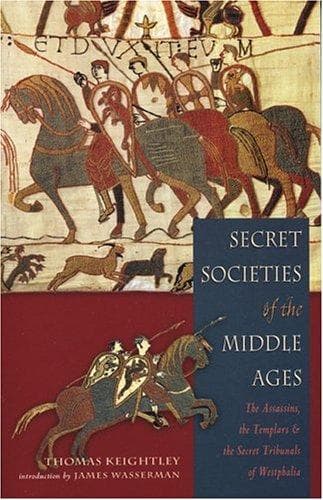
Secret Societies of the Middle AgesKeightley, Thomas
History
Secret Societies of the Middle Ages
Keightley, Thomas
Secret societies
We thus see that the evidence in favour of the King of England greatly
preponderates, not a single writer who was on the spot laying the murder
to his charge; on the contrary, those who had the best means of being
informed treated the imputation with contempt, as a base calumny devised
by the French party. But there is a still more illustrious witness in
his behalf, if the testimony ascribed to him be genuine--the Old Man of
the Mountain himself. Brompton gives two letters purporting to have been
written by this personage, the one to the Duke of Austria, the other to
the princes and people of Europe in general. The latter is also given by
William of Newbridge, with some variation. Both have been admitted by
Rymer into his Foedera. Gibbon, who seems to have known only the last,
pronounces it to be an "absurd and palpable forgery." Hammer, whose
arguments we shall presently consider, undertakes to demonstrate that
these epistles are forgeries. Raumer, more prudently, only says that
this last is not genuine in its present form.
The following are translations of these documents:--
"The Old Man of the Mountain to Limpold, Duke of Austria, greeting.
Since several kings and princes beyond sea accuse Richard, King of
England, and lord, of the death of the marquis, I swear by the God who
reigneth for ever, and by the law which we hold, that he had no guilt in
his death; for the cause of the death of the marquis was as follows.
"One of our brethren was coming in a ship from Satelia (_Salteleya_) to
our parts, and a tempest chancing to drive him to Tyre the marquis had
him taken and slain, and seized a large sum of money which he had with
him. But we sent our messengers to the marquis, requiring him to restore
to us the money of our brother, and to satisfy us respecting the death
of our brother, which he laid upon Reginald, the Lord of Sidon, and we
exerted ourselves through our friends till we knew of a truth that it
was he himself who had had him put to death, and had seized his money.
"And again we sent to him another of our messengers, named Eurisus, whom
he was minded to fling into the sea; but our friends made him depart
with speed out of Tyre, and he came to us quickly and told us these
things. From that very hour we were desirous to slay the marquis; then
also we sent two brethren to Tyre, who slew him openly, and as it were
before all the people of Tyre.
"This, then, was the cause of the death of the marquis; and we say to
you in truth that the lord Richard, King of England, had no guilt in
this death of the marquis, and these who on account of this have done
evil to the lord King of England have done it unjustly and without
cause.
"Know for certain that we kill no man in this world for any hire or
money, unless he has first done us evil.
"And know that we have executed these letters in our house at our castle
of Messiat, in the middle of September. In the year from Alexander M. D.
& V."
* * * * *
Public-domain text, read in full here on John Shaqi.
Reviews
Reviews
No reviews yet
Be the first to share your thoughts on this work.
Elsewhere in the archive
Join the Discussion
Join the discussion
Sign in to leave a comment or review.
Sign InorCreate an account