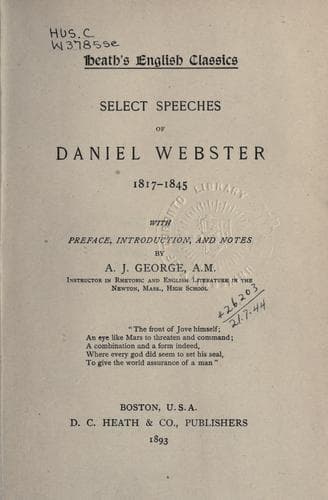
Select Speeches of Daniel Webster, 1817-1845Webster, Daniel
General
Select Speeches of Daniel Webster, 1817-1845
Webster, Daniel
Speeches, addresses, etc., American
Having had occasion to recur to the Ordinance of 1787, in order to
defend myself against the inferences which the honorable member has
chosen to draw from my former observations on that subject, I am not
willing now entirely to take leave of it without another remark. It
need hardly be said, that that paper expresses just sentiments on the
great subject of civil and religious liberty. Such sentiments were
common, and abound in all our state papers of that day. But this
Ordinance did that which was not so common, and which is not even now
universal; that is, it set forth and declared it to be a high and
binding duty of government itself to support schools and advance the
means of education, on the plain reason that religion, morality, and
knowledge are necessary to good government, and to the happiness of
mankind. One observation further. The important provision incorporated
into the Constitution of the United States, and into several of those
of the States, and recently, as we have seen, adopted into the reformed
constitution of Virginia, restraining legislative power in questions of
private right, and from impairing the obligation of contracts, is first
introduced and established, as far as I am informed, as matter of
express written constitutional law, in this Ordinance of 1787. And I
must add, also, in regard to the author of the Ordinance, who has not
had the happiness to attract the gentleman's notice heretofore, nor to
avoid his sarcasm now, that he was chairman of that select committee of
the old Congress, whose report first expressed the strong sense of that
body, that the old Confederation was not adequate to the exigencies of
the country, and recommended to the States to send delegates to the
convention which formed the present Constitution.
An attempt has been made to transfer from the North to the South the
honor of this exclusion of slavery from the Northwestern Territory. The
journal, without argument or comment, refutes such attempts. The
cession by Virginia was made in March, 1784. On the 19th of April
following, a committee, consisting of Messrs. Jefferson, Chase, and
Howell, reported a plan for a temporary government of the territory, in
which was this article: "That, after the year 1800, there shall be
neither slavery nor involuntary servitude in any of the said States,
otherwise than in punishment of crimes, whereof the party shall have
been convicted." Mr. Spaight of North Carolina moved to strike out this
paragraph. The question was put, according to the form then practised,
"Shall these words stand as a part of the plan?" New Hampshire,
Massachusetts, Rhode Island, Connecticut, New York, New Jersey, and
Pennsylvania, seven States, voted in the affirmative; Maryland,
Virginia, and South Carolina, in the negative. North Carolina was
divided. As the consent of nine States was necessary, the words could
not stand, and were struck out accordingly. Mr. Jefferson voted for the
clause, but was overruled by his colleagues.
Public-domain text, read in full here on John Shaqi.
Reviews
Reviews
No reviews yet
Be the first to share your thoughts on this work.
Elsewhere in the archive
Join the Discussion
Join the discussion
Sign in to leave a comment or review.
Sign InorCreate an account