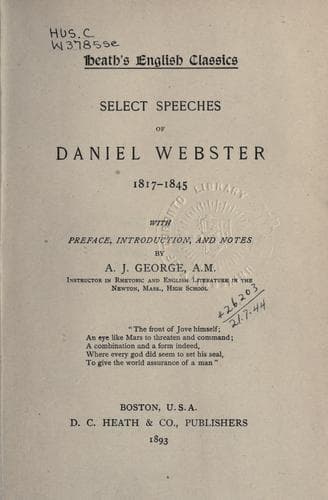
Select Speeches of Daniel Webster, 1817-1845Webster, Daniel
General
Select Speeches of Daniel Webster, 1817-1845
Webster, Daniel
Speeches, addresses, etc., American
We approach, at length, Sir, to a more important part of the honorable
gentleman's observations. Since it does not accord with my views of
justice and policy to give away the public lands altogether, as a mere
matter of gratuity, I am asked by the honorable gentleman on what
ground it is that I consent to vote them away in particular instances.
How, he inquires, do I reconcile with these professed sentiments, my
support of measures appropriating portions of the lands to particular
roads, particular canals, particular rivers, and particular
institutions of education in the West? This leads, Sir, to the real and
wide difference in political opinion between the honorable gentleman
and myself. On my part, I look upon all these objects as connected with
the common good, fairly embraced in its object and its terms; he, on
the contrary, deems them all, if good at all, only local good. This is
our difference. The interrogatory which he proceeded to put at once
explains this difference. "What interest," asks he, "has South Carolina
in a canal in Ohio?" Sir, this very question is full of significance.
It develops the gentleman's whole political system; and its answer
expounds mine. Here we differ. I look upon a road over the Alleghenies,
a canal round the falls of the Ohio, or a canal or railway from the
Atlantic to the Western waters, as being an object large and extensive
enough to be fairly said to be for the common benefit. The gentleman
thinks otherwise, and this is the key to his construction of the powers
of the government. He may well ask what interest has South Carolina in
a canal in Ohio. On his system, it is true, she has no interest. On
that system, Ohio and Carolina are different governments, and different
countries; connected here, it is true, by some slight and ill-defined
bond of union, but in all main respects separate and diverse. On that
system, Carolina has no more interest in a canal in Ohio than in
Mexico. The gentleman, therefore, only follows out his own principles;
he does no more than arrive at the natural conclusions of his own
doctrines; he only announces the true results of that creed which he
has adopted himself, and would persuade others to adopt, when he thus
declares that South Carolina has no interest in a public work in Ohio.
Public-domain text, read in full here on John Shaqi.
Reviews
Reviews
No reviews yet
Be the first to share your thoughts on this work.
Elsewhere in the archive
Join the Discussion
Join the discussion
Sign in to leave a comment or review.
Sign InorCreate an account