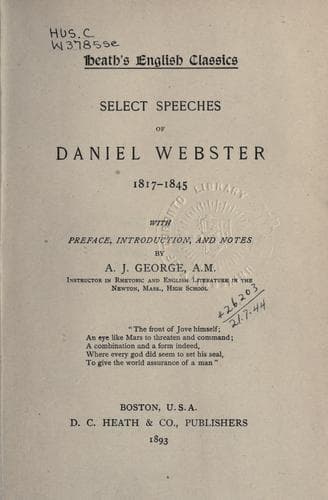
Select Speeches of Daniel Webster, 1817-1845Webster, Daniel
General
Select Speeches of Daniel Webster, 1817-1845
Webster, Daniel
Speeches, addresses, etc., American
The tariff of 1816, (one of the plain cases of oppression and
usurpation, from which, if the government does not recede, individual
States may justly secede from the government,) is, Sir, in truth, a
South Carolina tariff, supported by South Carolina votes. But for those
votes, it could not have passed in the form in which it did pass;
whereas, if it had depended on Massachusetts votes, it would have been
lost. Does not the honorable gentleman well know all this? There are
certainly those who do, full well, know it all. I do not say this to
reproach South Carolina. I only state the fact; and I think it will
appear to be true, that among the earliest and boldest advocates of the
tariff, as a measure of protection, and on the express ground of
protection, were leading gentlemen of South Carolina in Congress. I did
not then, and cannot now, understand their language in any other sense.
While this tariff of 1816 was under discussion in the House of
Representatives, an honorable gentleman from Georgia, [13] now of this
house, moved to reduce the proposed duty on cotton. He failed, by four
votes, South Carolina giving three votes (enough to have turned the
scale) against his motion. The act, Sir, then passed, and received on
its passage the support of a majority of the Representatives of South
Carolina present and voting. This act is the first in the order of
those now denounced as plain usurpations. We see it daily in the list,
by the side of those of 1824 and 1828, as a case of manifest
oppression, justifying disunion. I put it home to the honorable member
from South Carolina, that his own State was not only "art and part" in
this measure, but the _causa causans_. Without her aid, this seminal
principle of mischief, this root of Upas, could not have been planted.
I have already said, and it is true, that this act proceeded on the
ground of protection. It interfered directly with existing interests of
great value and amount. It cut up the Calcutta cotton trade by the
roots; but it passed, nevertheless, and it passed on the principle of
protecting manufactures, on the principle against free trade, on the
principle opposed to that _which lets us alone_. [14]
Public-domain text, read in full here on John Shaqi.
Reviews
Reviews
No reviews yet
Be the first to share your thoughts on this work.
Elsewhere in the archive
Join the Discussion
Join the discussion
Sign in to leave a comment or review.
Sign InorCreate an account