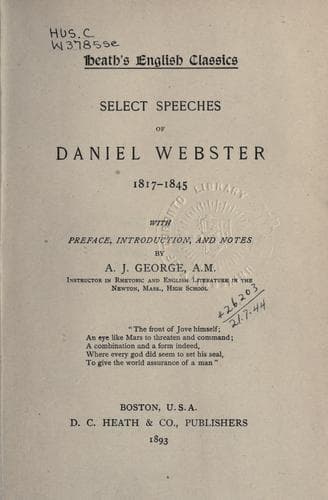
Select Speeches of Daniel Webster, 1817-1845Webster, Daniel
General
Select Speeches of Daniel Webster, 1817-1845
Webster, Daniel
Speeches, addresses, etc., American
This last alternative did not suit our principles, and of course we
adopted the former. In 1827, the subject came again before Congress, on
a proposition to afford some relief to the branch of wool and woollens.
We looked upon the system of protection as being fixed and settled. The
law of 1824 remained. It had gone into full operation, and, in regard
to some objects intended by it, perhaps most of them, had produced all
its expected effects. No man proposed to repeal it; no man attempted to
renew the general contest on its principle. But, owing to subsequent
and unforeseen occurrences, the benefit intended by it to wool and
woollen fabrics had not been realized. Events not known here when the
law passed had taken place, which defeated its object in that
particular respect. A measure was accordingly brought forward to meet
this precise deficiency, to remedy this particular defect. It was
limited to wool and woollens. Was ever anything more reasonable? If the
policy of the tariff laws had become established in principle, as the
permanent policy of the government, should they not be revised and
amended, and made equal, like other laws, as exigencies should arise,
or justice require? Because we had doubted about adopting the system,
were we to refuse to cure its manifest defects, after it had been
adopted, and when no one attempted its repeal? And this, Sir, is the
inconsistency so much bruited. I had voted against the tariff of 1824,
but it passed; and in 1827 and 1828 I voted to amend it, in a point
essential to the interest of my constituents. Where is the
inconsistency? Could I do otherwise? Sir, does political consistency
consist in always giving negative votes? Does it require of a public
man to refuse to concur in amending laws, because they passed against
his consent? Having voted against the tariff originally, does
consistency demand that I should do all in my power to maintain an
unequal tariff, burdensome to my own constituents in many respects,
favorable in none? To consistency of that sort, I lay no claim. And
there is another sort to which I lay as little, and that is, a kind of
consistency by which persons feel themselves as much bound to oppose a
proposition after it has become a law of the land as before.
Public-domain text, read in full here on John Shaqi.
Reviews
Reviews
No reviews yet
Be the first to share your thoughts on this work.
Elsewhere in the archive
Join the Discussion
Join the discussion
Sign in to leave a comment or review.
Sign InorCreate an account