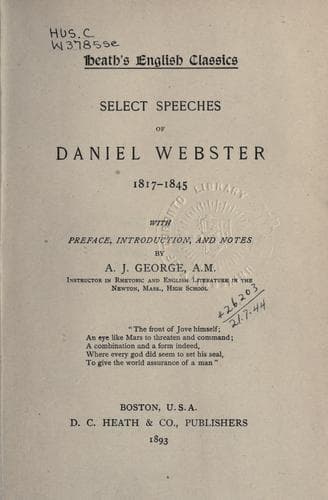
Select Speeches of Daniel Webster, 1817-1845Webster, Daniel
General
Select Speeches of Daniel Webster, 1817-1845
Webster, Daniel
Speeches, addresses, etc., American
This leads us to inquire into the origin of this government and the
source of its power. Whose agent is it? Is it the creature of the State
legislatures, or the creature of the people? If the government of the
United States be the agent of the State governments, then they may
control it, provided they can agree in the manner of controlling it; if
it be the agent of the people, then the people alone can control it,
restrain it, modify, or reform it. It is observable enough, that the
doctrine for which the honorable gentleman contends leads him to the
necessity of maintaining, not only that this general government is the
creature of the States, but that it is the creature of each of the
States severally, so that each may assert the power for itself of
determining whether it acts within the limits of its authority. It is
the servant of four-and-twenty masters, of different wills and
different purposes, and yet bound to obey all. This absurdity (for it
seems no less) arises from a misconception as to the origin of this
government and its true character. It is, Sir, the people's
Constitution, the people's government, made for the people, made by the
people, and answerable to the people. The people of the United States
have declared that this Constitution shall be the supreme law. We must
either admit the proposition, or dispute their authority. The States
are, unquestionably, sovereign, so far as their sovereignty is not
affected by the supreme law. But the State legislatures, as political
bodies, however sovereign, are yet not sovereign over the people. So
far as the people have given power to the general government, so far
the grant is unquestionably good, and the government holds of the
people, and not of the State governments. We are all agents of the same
supreme power, the people. The general government and the State
governments derive their authority from the same source. Neither can,
in relation to the other, be called primary, though one is definite and
restricted, and the other general and residuary. The national
government possesses those powers which it can be shown the people have
conferred on it, and no more. All the rest belongs to the State
governments, or to the people themselves. So far as the people have
restrained State sovereignty, by the expression of their will, in the
Constitution of the United States, so far, it must be admitted, State
sovereignty is effectually controlled. I do not contend that it is, or
ought to be, controlled farther. The sentiment to which I have referred
propounds that State sovereignty is only to be controlled by its own
"feeling of justice"; that is to say, it is not to be controlled at
all, for one who is to follow his own feelings is under no legal
control. Now, however men may think this ought to be, the fact is, that
the people of the United States have chosen to impose control on State
sovereignties. There are those, doubtless, who wish they had been left
Public-domain text, read in full here on John Shaqi.
Reviews
Reviews
No reviews yet
Be the first to share your thoughts on this work.
Elsewhere in the archive
Join the Discussion
Join the discussion
Sign in to leave a comment or review.
Sign InorCreate an account