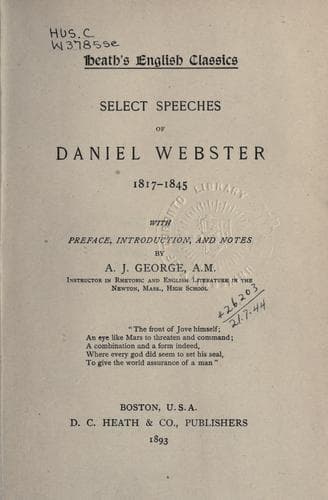
Select Speeches of Daniel Webster, 1817-1845Webster, Daniel
General
Select Speeches of Daniel Webster, 1817-1845
Webster, Daniel
Speeches, addresses, etc., American
The gentleman has found no case, he can find none, to support his own
opinions by New England authority. New England has studied the
Constitution in other schools, and under other teachers. She looks upon
it with other regards, and deems more highly and reverently both of its
just authority and its utility and excellence. The history of her
legislative proceedings may be traced. The ephemeral effusions of
temporary bodies, called together by the excitement of the occasion,
may be hunted up; they have been hunted up. The opinions and votes of
her public men, in and out of Congress, may be explored. It will all be
in vain. The Carolina doctrine can derive from her neither countenance
nor support. She rejects it now; she always did reject it; and till she
loses her senses, she always will reject it. The honorable member has
referred to expressions on the subject of the embargo law, made in this
place, by an honorable and venerable gentleman, now favoring us with
his presence. [24] He quotes that distinguished Senator as saying,
that, in his judgment, the embargo law was unconstitutional, and that
therefore, in his opinion, the people were not bound to obey it. That,
Sir, is perfectly constitutional language. An unconstitutional law is
not binding; _but then it does not rest with a resolution or a law of a
State legislature to decide whether an act of Congress be or be not
constitutional_. An unconstitutional act of Congress would not bind the
people of this District, although they have no legislature to interfere
in their behalf; and, on the other hand, a constitutional law of
Congress does bind the citizens of every State, although all their
legislatures should undertake to annul it by act or resolution. The
venerable Connecticut Senator is a constitutional lawyer, of sound
principles and enlarged knowledge; a statesman practised and
experienced, bred in the company of Washington, and holding just views
upon the nature of our governments. He believed the embargo
unconstitutional, and so did others; but what then? Who did he suppose
was to decide that question? The State legislatures? Certainly not. No
such sentiment ever escaped his lips.
Public-domain text, read in full here on John Shaqi.
Reviews
Reviews
No reviews yet
Be the first to share your thoughts on this work.
Elsewhere in the archive
Join the Discussion
Join the discussion
Sign in to leave a comment or review.
Sign InorCreate an account