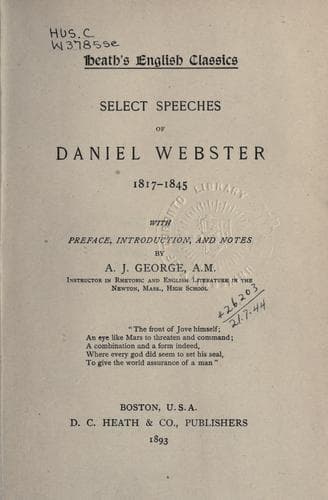
Select Speeches of Daniel Webster, 1817-1845Webster, Daniel
General
Select Speeches of Daniel Webster, 1817-1845
Webster, Daniel
Speeches, addresses, etc., American
Sir, the human mind is so constituted, that the merits of both sides of
a controversy appear very clear, and very palpable, to those who
respectively espouse them; and both sides usually grow clearer as the
controversy advances. South Carolina sees unconstitutionality in the
tariff; she sees oppression there also, and she sees danger.
Pennsylvania, with a vision not less sharp, looks at the same tariff,
and sees no such thing in it; she sees it all constitutional, all
useful, all safe. The faith of South Carolina is strengthened by
opposition, and she now not only sees, but _resolves_, that the tariff
is palpably unconstitutional, oppressive, and dangerous; but
Pennsylvania, not to be behind her neighbors, and equally willing to
strengthen her own faith by a confident asseveration, _resolves_, also,
and gives to every warm affirmative of South Carolina, a plain,
downright, Pennsylvania negative. South Carolina, to show the strength
and unity of her opinion, brings her assembly to a unanimity, within
seven voices; Pennsylvania, not to be outdone in this respect any more
than in others, reduces her dissentient fraction to a single vote. Now,
Sir, again, I ask the gentleman, What is to be done? Are these States
both right? Is he bound to consider them both right? If not, which is
in the wrong? or rather, which has the best right to decide? And if he,
and if I, are not to know what the Constitution means, and what it is,
till those two State legislatures, and the twenty-two others, shall
agree in its construction, what have we sworn to, when we have sworn to
maintain it? I was forcibly struck, Sir, with one reflection, as the
gentleman went on in his speech. He quoted Mr. Madison's resolutions,
to prove that a State may interfere, in a case of deliberate, palpable,
and dangerous exercise of a power not granted. The honorable member
supposes the tariff law to be such an exercise of power; and that
consequently a case has arisen in which the State may, if it see fit,
interfere by its own law. Now it so happens, nevertheless, that Mr.
Madison deems this same tariff law quite constitutional. Instead of a
clear and palpable violation, it is, in his judgment, no violation at
all. So that, while they use his authority for a hypothetical case,
they reject it in the very case before them. All this, Sir, shows the
inherent futility, I had almost used a stronger word, of conceding this
power of inference to the State, and then attempting to secure it from
abuse by imposing qualifications of which the States themselves are to
judge. One of two things is true; either the laws of the Union are
beyond the discretion and beyond the control of the States; or else we
have no constitution of general government, and are thrust back again
to the days of the Confederation.
Public-domain text, read in full here on John Shaqi.
Reviews
Reviews
No reviews yet
Be the first to share your thoughts on this work.
Elsewhere in the archive
Join the Discussion
Join the discussion
Sign in to leave a comment or review.
Sign InorCreate an account