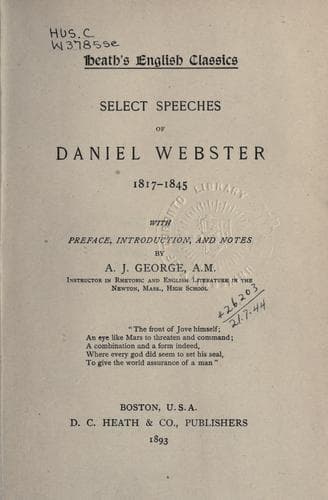
Select Speeches of Daniel Webster, 1817-1845Webster, Daniel
General
Select Speeches of Daniel Webster, 1817-1845
Webster, Daniel
Speeches, addresses, etc., American
If anything be found in the national Constitution, either by original
provision or subsequent interpretation, which ought not to be in it,
the people know how to get rid of it. If any construction, unacceptable
to them, be established, so as to become practically a part of the
Constitution, they will amend it at their own sovereign pleasure. But
while the people choose to maintain it as it is, while they are
satisfied with it, and refuse to change it, who has given, or who can
give, to the State legislatures a right to alter it, either by
interference, construction, or otherwise? Gentlemen do not seem to
recollect that the people have any power to do anything for themselves.
They imagine there is no safety for them, any longer than they are
under the close guardianship of the State legislatures. Sir, the people
have not trusted their safety in regard to the general Constitution to
these hands. They have required other security, and taken other bonds.
They have chosen to trust themselves, first, to the plain words of the
instrument, and to such construction as the government themselves, in
doubtful cases, should put on their own powers, under their oaths of
office, and subject to their responsibility to them; just as the people
of a State trust their own State governments with a similar power.
Secondly, they have reposed their trust in the efficacy of frequent
elections, and in their own power to remove their own servants and
agents whenever they see cause. Thirdly, they have reposed trust in the
judicial power, which, in order that it might be trustworthy, they have
made as respectable, as disinterested, and as independent as was
practicable. Fourthly, they have seen fit to rely, in case of
necessity, or high expediency, on their known and admitted power to
alter or amend the Constitution, peaceably and quietly, whenever
experience shall point out defects or imperfections. And, finally, the
people of the United States have at no time, in no way, directly or
indirectly, authorized any State legislature to construe or interpret
_their_ high instrument of government; much less to interfere, by their
own power, to arrest its course and operation.
If, Sir, the people in these respects had done otherwise than they have
done, their Constitution could neither have been preserved, nor would
it have been worth preserving. And if its plain provisions shall now be
disregarded, and these new doctrines interpolated in it, it will become
as feeble and helpless a being as its enemies, whether early or more
recent, could possibly desire. It will exist in every State but as a
poor dependent on State permission. It must borrow leave to be; and
will be, no longer than State pleasure, or State discretion, sees fit
to grant the indulgence, and to prolong its poor existence.
Public-domain text, read in full here on John Shaqi.
Reviews
Reviews
No reviews yet
Be the first to share your thoughts on this work.
Elsewhere in the archive
Join the Discussion
Join the discussion
Sign in to leave a comment or review.
Sign InorCreate an account