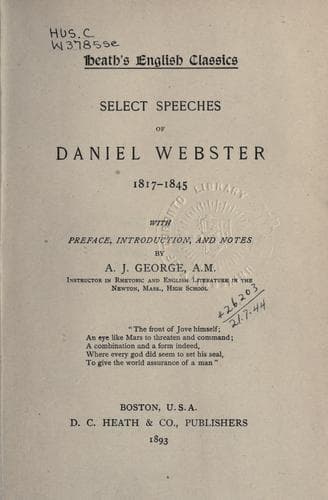
Select Speeches of Daniel Webster, 1817-1845Webster, Daniel
General
Select Speeches of Daniel Webster, 1817-1845
Webster, Daniel
Speeches, addresses, etc., American
The first two resolutions of the honorable member affirm these
propositions, viz.:--
1. That the political system under which we live, and under which
Congress is now assembled, is a _compact_, to which the people of the
several States, as separate and sovereign communities, are _the
parties_.
2. That these sovereign parties have a right to judge, each for itself,
of any alleged violation of the Constitution by Congress; and, in case
of such violation, to choose, each for itself, its own mode and measure
of redress.
It is true, Sir, that the honorable member calls this a
"constitutional" compact; but still he affirms it to be a compact
between sovereign States. What precise meaning, then, does he attach to
the term _constitutional_? When applied to compacts between sovereign
States, the term _constitutional_ affixes to the word _compact_ no
definite idea. Were we to hear of a constitutional league or treaty
between England and France, or a constitutional convention between
Austria and Russia, we should not understand what could be intended by
such a league, such a treaty, or such a convention. In these
connections, the word is void of all meaning; and yet, Sir, it is easy,
quite easy, to see why the honorable gentleman has used it in these
resolutions. He cannot open the book, and look upon our written frame
of government, without seeing that it is called a _constitution_. This
may well be appalling to him. It threatens his whole doctrine of
compact, and its darling derivatives, nullification and secession, with
instant confutation. Because, if he admits our instrument of government
to be a _constitution_, then, for that very reason, it is not a compact
between sovereigns; a constitution of government and a compact between
sovereign powers being things essentially unlike in their very natures,
and incapable of ever being the same. Yet the word _constitution_ is on
the very front of the instrument. He cannot overlook it. He seeks,
therefore, to compromise the matter, and to sink all the substantial
sense of the word, while he retains a resemblance of its sound. He
introduces a new word of his own, viz. _compact_, as importing the
principal idea, and designed to play the principal part, and degrades
_constitution_ into an insignificant, idle epithet, attached to
_compact_. The whole then stands as a _"constitutional compact"!_ And
in this way he hopes to pass off a plausible gloss, as satisfying the
words of the instrument. But he will find himself disappointed. Sir, I
must say to the honorable gentleman, that, in our American political
grammar, CONSTITUTION is a noun substantive; it imports a distinct and
clear idea of itself; and it is not to lose its importance and dignity,
it is not to be turned into a poor, ambiguous, senseless, unmeaning
adjective, for the purpose of accommodating any new set of political
notions. Sir, we reject his new rules of syntax altogether. We will not
Public-domain text, read in full here on John Shaqi.
Reviews
Reviews
No reviews yet
Be the first to share your thoughts on this work.
Elsewhere in the archive
Join the Discussion
Join the discussion
Sign in to leave a comment or review.
Sign InorCreate an account