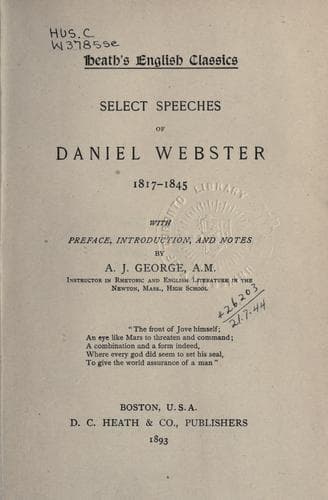
Select Speeches of Daniel Webster, 1817-1845Webster, Daniel
General
Select Speeches of Daniel Webster, 1817-1845
Webster, Daniel
Speeches, addresses, etc., American
If men will open their eyes fairly to the lights of history, it is
impossible to be deceived on this point. The great object was to
supersede the Confederation by a regular government; because, under the
Confederation, Congress had power only to make requisitions on States;
and if States declined compliance, as they did, there was no remedy but
war against such delinquent States. It would seem, from Mr. Jefferson's
correspondence, in 1786 and 1787, that he was of opinion that even this
remedy ought to be tried. "There will be no money in the treasury,"
said he, "till the confederacy shows its teeth"; and he suggests that a
single frigate would soon levy, on the commerce of a delinquent State,
the deficiency of its contribution. But this would be war; and it was
evident that a confederacy could not long hold together, which should
be at war with its members. The Constitution was adopted to avoid this
necessity. It was adopted that there might be a government which should
act directly on individuals, without borrowing aid from the State
governments. This is clear as light itself on the very face of the
provisions of the Constitution, and its whole history tends to the same
conclusion. Its framers gave this very reason for their work in the
most distinct terms. Allow me to quote but one or two proofs, out of
hundreds. That State, so small in territory, but so distinguished for
learning and talent, Connecticut, had sent to the general Convention,
among other members, Samuel Johnston and Oliver Ellsworth. The
Constitution having been framed, it was submitted to a convention of
the people of Connecticut for ratification on the part of that State;
and Mr. Johnston and Mr. Ellsworth were also members of this
convention. On the first day of the debates, being called on to explain
the reasons which led the Convention at Philadelphia to recommend such
a Constitution, after showing the insufficiency of the existing
confederacy, inasmuch as it applied to States, as States, Mr. Johnston
proceeded to say:--
"The Convention saw this imperfection in attempting to legislate for
States in their political capacity, that the coercion of law can be
exercised by nothing but a military force. They have, therefore, gone
upon entirely new ground. They have formed one new nation out of the
individual States. The Constitution vests in the general legislature a
power to make laws in matters of national concern; to appoint judges to
decide upon these laws; and to appoint officers to carry them into
execution. This excludes the idea of an armed force. The power which is
to enforce these laws is to be a legal power, vested in proper
magistrates. The force which is to be employed is the energy of law;
and this force is to operate only upon individuals who fail in their
duty to their country. This is the peculiar glory of the Constitution,
that it depends upon the mild and equal energy of the magistracy for
the execution of the laws."
Public-domain text, read in full here on John Shaqi.
Reviews
Reviews
No reviews yet
Be the first to share your thoughts on this work.
Elsewhere in the archive
Join the Discussion
Join the discussion
Sign in to leave a comment or review.
Sign InorCreate an account