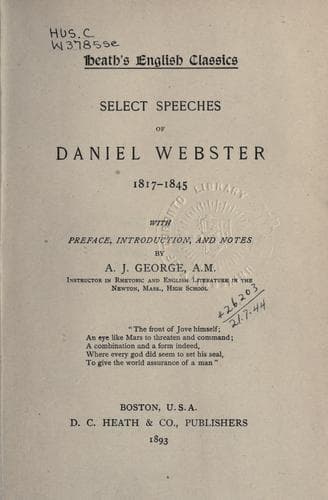
Select Speeches of Daniel Webster, 1817-1845Webster, Daniel
General
Select Speeches of Daniel Webster, 1817-1845
Webster, Daniel
Speeches, addresses, etc., American
Sir, the honorable gentleman from South Carolina has referred to two
incidents connected with the proceedings of the Convention at
Philadelphia, which he thinks are evidence to show that the power of
protecting manufactures by laying duties, and by commercial
regulations, was not intended to be given to Congress. The first is, as
he says, that a power to protect manufactures was expressly proposed,
but not granted. I think, Sir, the gentleman is quite mistaken in
relation to this part of the proceedings of the Convention. The whole
history of the occurrence to which he alludes is simply this. Towards
the conclusion of the Convention, after the provisions of the
Constitution had been mainly agreed upon, after the power to lay duties
and the power to regulate commerce had both been granted, a long list
of propositions was made and referred to the committee, containing
various miscellaneous powers, some or all of which it was thought might
be properly vested in Congress. Among these was a power to establish a
university; to grant charters of incorporation; to regulate
stage-coaches on the post-roads; and also the power to which the
gentleman refers, and which is expressed in these words: "To establish
public institutions, rewards, and immunities, for the promotion of
agriculture, commerce, trades, and manufactures." The committee made no
report on this or various other propositions in the same list. But the
only inference from this omission is, that neither the committee nor
the Convention thought it proper to authorize Congress "to establish
public institutions, rewards, and immunities," for the promotion of
manufactures, and other interests. The Convention supposed it had done
enough,--at any rate, it had done all it intended,--when it had given
to Congress, in general terms, the power to lay imposts and the power
to regulate trade. It is not to be argued, from its omission to give
more, that it meant to take back what it had already given. It had
given the impost power; it had given the regulation of trade; and it
did not deem it necessary to give the further and distinct power of
establishing public institutions.
The other fact, Sir, on which the gentleman relies, is the declaration
of Mr. Martin to the legislature of Maryland. The gentleman supposes
Mr. Martin to have urged against the Constitution, that it did not
contain the power of protection. But if the gentleman will look again
at what Mr. Martin said, he will find, I think, that what Mr. Martin
complained of was, that the Constitution, by its prohibitions on the
States, had taken away from the States themselves the power of
protecting their own manufactures by duties on imports. This is
undoubtedly true; but I find no expression of Mr. Martin intimating
that the Constitution had not conferred on Congress the same power
which it had thus taken from the States.
Public-domain text, read in full here on John Shaqi.
Reviews
Reviews
No reviews yet
Be the first to share your thoughts on this work.
Elsewhere in the archive
Join the Discussion
Join the discussion
Sign in to leave a comment or review.
Sign InorCreate an account