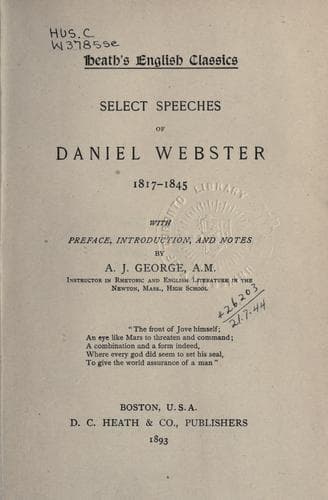
Select Speeches of Daniel Webster, 1817-1845Webster, Daniel
General
Select Speeches of Daniel Webster, 1817-1845
Webster, Daniel
Speeches, addresses, etc., American
But the great leader, Sir, on this occasion, was Mr. Madison. Was _he_
likely to know the intentions of the Convention and the people? Was
_he_ likely to understand the Constitution? At the second sitting of
the committee, Mr. Madison explained his own opinions of the duty of
Congress, fully and explicitly. I must not detain you, Sir, with more
than a few short extracts from these opinions, but they are such as are
clear, intelligible, and decisive. "The States," says he, "that are
most advanced in population, and ripe for manufacturers, ought to have
their particular interest attended to, in some degree. While these
States retained the power of making regulations of trade, they had the
power to cherish such institutions. By adopting the present
Constitution, they have thrown the exercise of this power into other
hands; they must have done this with an expectation that those
interests would not be neglected here." In another report of the same
speech, Mr. Madison is represented as using still stronger language; as
saying that, the Constitution having taken this power away from the
States and conferred it on Congress, it would be a _fraud_ on the
States and on the people were Congress to refuse to exercise it.
Mr. Madison argues, Sir, on this early and interesting occasion, very
justly and liberally, in favor of the general principles of
unrestricted commerce. But he argues, also, with equal force and
clearness, for certain important exceptions to these general
principles. The first, Sir, respects those manufactures which had been
brought forward under encouragement by the State governments. "It would
be cruel," says Mr. Madison, "to neglect them, and to divert their
industry into other channels; for it is not possible for the hand of
man to shift from one employment to another without being injured by
the change." Again: "There may be some manufactures which, being once
formed, can advance towards perfection without any adventitious aid;
while others, for want of the fostering hand of government, will be
unable to go on at all. Legislative provision, therefore, will be
necessary to collect the proper objects for this purpose; and this will
form another exception to my general principle." And again: "The next
exception that occurs is one on which great stress is laid by some
well-informed men, and this with great plausibility; that each nation
should have, within itself, the means of defence, independent of
foreign supplies; that, in whatever relates to the operations of war,
no State ought to depend upon a precarious supply from any part of the
world. There may be some truth in this remark; and therefore it is
proper for legislative attention."
Public-domain text, read in full here on John Shaqi.
Reviews
Reviews
No reviews yet
Be the first to share your thoughts on this work.
Elsewhere in the archive
Join the Discussion
Join the discussion
Sign in to leave a comment or review.
Sign InorCreate an account