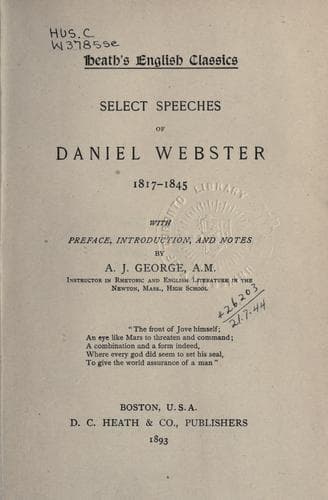
Select Speeches of Daniel Webster, 1817-1845Webster, Daniel
General
Select Speeches of Daniel Webster, 1817-1845
Webster, Daniel
Speeches, addresses, etc., American
Mr. President, this power of _discrimination_, thus admitted, avowed,
and practised upon in the first revenue act, has never been denied or
doubted until within a few years past. It was not at all doubted in
1816, when it became necessary to adjust the revenue to a state of
peace. On the contrary, the power was then exercised, not without
opposition as to its expediency, but, as far as I remember or have
understood, without the slightest opposition founded on any supposed
want of constitutional authority. Certainly, South Carolina did not
doubt it. The tariff of 1816 was introduced, carried through, and
established, under the lead of South Carolina. Even the minimum policy
is of South Carolina origin. The honorable gentleman himself supported,
and ably supported, the tariff of 1816. He has informed us, Sir, that
his speech on that occasion was sudden and off-hand, he being called up
by the request of a friend. I am sure the gentleman so remembers it,
and that it was so; but there is, nevertheless, much method,
arrangement, and clear exposition in that extempore speech. It is very
able, very, very much to the point, and very decisive. And in another
speech, delivered two months earlier, on the proposition to repeal the
internal taxes, the honorable gentleman had touched the same subject,
and had declared "_that a certain encouragement ought to be extended at
least to our woollen and cotton manufactures_." I do not quote these
speeches, Sir, for the purpose of showing that the honorable gentleman
has changed his opinion: my object is other and higher. I do it for the
sake of saying that that cannot be so plainly and palpably
unconstitutional as to warrant resistance to law, nullification, and
revolution, which the honorable gentleman and his friends have
heretofore agreed to and acted upon without doubt and without
hesitation. Sir, it is no answer to say that the tariff of 1816 was a
revenue bill. So are they all revenue bills. The point is, and the
truth is, that the tariff of 1816, like the rest, _did discriminate_;
it did distinguish one article from another; it did lay duties for
protection. Look to the case of coarse cottons under the minimum
calculation: the duty on these was from sixty to eighty per cent.
Something beside revenue, certainly, was intended in this; and, in
fact, the law cut up our whole commerce with India in that article.
Public-domain text, read in full here on John Shaqi.
Reviews
Reviews
No reviews yet
Be the first to share your thoughts on this work.
Elsewhere in the archive
Join the Discussion
Join the discussion
Sign in to leave a comment or review.
Sign InorCreate an account