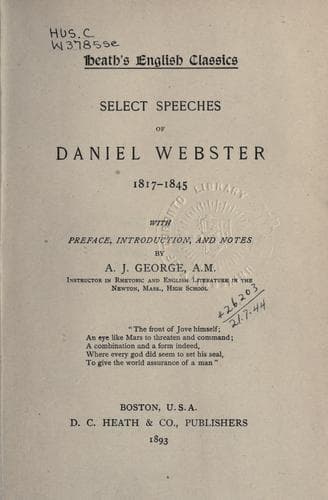
Select Speeches of Daniel Webster, 1817-1845Webster, Daniel
General
Select Speeches of Daniel Webster, 1817-1845
Webster, Daniel
Speeches, addresses, etc., American
What produced this change of views? Down to March of the same year,
nothing of this sort was indicated or threatened. What, then, induced
the change? [A voice from the crowd said, "Martin Van Buren."] If that
be so, it was the production of mighty consequences by a cause not at
all proportioned. I will state, in connection with, and in elucidation
of, this subject, certain transactions, which constitute one of those
contingencies in human affairs, in which casual circumstances, acting
upon the peculiar temper and character of a man of very decided temper
and character, affect the fate of nations. A movement was made in the
summer of 1829, for the purpose of effecting a change of certain
officers of the branch of the Bank of the United States in Portsmouth,
New Hampshire. Mr. Woodbury, then a Senator from New Hampshire,
transmitted to the president of the bank at Philadelphia a request;
purporting to proceed from merchants and men of business of all
parties, asking the removal of the president of that branch, _not on
political grounds_, but as acceptable and advantageous to the business
community. At the same time, Mr. Woodbury addressed a letter to the
then Secretary of the Treasury, Mr. Ingham, suggesting that his
department should, on _political grounds_, obtain from the mother bank
the removal of the branch president. This letter was transmitted to the
president of the mother bank, and reached him about the same time with
the other, so that, looking upon this picture and upon that, upon one
letter, which urged the removal on political grounds, and upon the
other, which denied that political considerations entered into the
matter at all, he concluded to let things remain as they were. Appeals
were then artfully made to the President of the United States. His
feelings were enlisted, and it is well known that, when he had an
object in view, his character was to go ahead.[2] I mean to speak no
evil nor disrespect of General Jackson. He has passed off the stage to
his retirement at the Hermitage, which it would be as well, perhaps,
that friends should not disturb, and where I sincerely wish he may, in
tranquillity, pass the residue of his days. But General Jackson's
character was imperious; he took the back track never; and however his
friends might differ, or whether they concurred or dissented, they were
fain always to submit. General Jackson put forth the pretension, that
appointments by the bank should have regard to the wishes of the
treasury; the matter was formally submitted to the directors of the
bank, and they as formally determined that the treasury could not
rightly or properly have any thing to say in the matter. A long and
somewhat angry correspondence ensued; for General Jackson found in the
president of the bank a man who had something of his own quality. The
result was that the bank resisted, and refused the required
acquiescence in the dictation of the treasury.
Public-domain text, read in full here on John Shaqi.
Reviews
Reviews
No reviews yet
Be the first to share your thoughts on this work.
Elsewhere in the archive
Join the Discussion
Join the discussion
Sign in to leave a comment or review.
Sign InorCreate an account