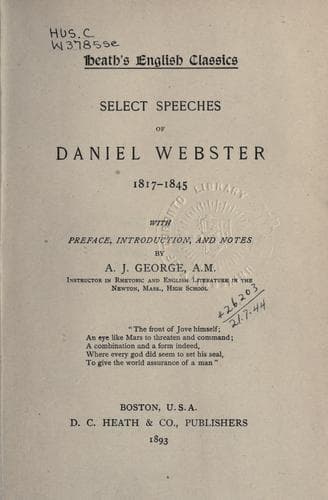
Select Speeches of Daniel Webster, 1817-1845Webster, Daniel
General
Select Speeches of Daniel Webster, 1817-1845
Webster, Daniel
Speeches, addresses, etc., American
Do we not know that there must always be bank paper? Is there a man
here who expects that he, or his children, or his children's children,
shall see the day when only gold coin, glittering through silk purses,
will be the currency of the country, to the entire exclusion of bank
notes? Not one. But we are told that the value of these notes is
questionable. It is the neglect of government to perform its duties
that makes them so. You here, in New York, have sound bank paper,
redeemable in coin; and if you were surrounded by a Chinese wall, it
might be indifferent to you whether government looked after the
currency elsewhere or not. But you have daily business relations with
Pennsylvania, and with the West, and East, and South, and you have a
direct interest that their currency too shall be sound; for otherwise
the very superiority of yours is, to a certain degree, an injury and
loss to you, since you pay in the equivalent of specie for what you
buy, and you sell for such money as may circulate in the States with
which you deal. But New York cannot affect the general restoration of
the currency, nor any one State, nor any number of States short of the
whole, and hence the duty of the general government to superintend this
interest.
But what does the sub-treasury propose? [6] Its basis is a separation
of the concerns of the treasury from those of the people. It directs
that there shall be certain vaults, and safes, and rooms for deposit of
the money of the government. But it has not been for want of adequate
vaults and rooms that we have lost our money, but owing to the hands to
which we have intrusted the keys. It is in the character of the
officers, and not in the strength of bars and vaults, that we must look
for the security of the public treasure. There are no securities under
this new system of keeping the public moneys that we had not before;
while many that did exist, in the personal character, high trusts, and
diversified duties of the officers and directors of banks are removed.
Moreover, the number of receiving and disbursing officers is increased,
and the danger to the public treasure is increased in proportion. The
next provision is, that money once received into the treasury is not to
be lent out. Yet the practice of this government hitherto has always
been opposed to this policy of locking up the money of the people, when
and while it is not required for the public service. Until this time
the public deposits, like private deposits, were used by the banks in
which they were placed, as some compensation for the trouble of
safe-keeping, and in furtherance of the general convenience. The next
provision is that requiring, after 1843, all dues to the government to
be paid in gold and silver. But what are we promised as the equivalent
for all this inconvenience and oppression? Why, that the government in
its turn will pay its debts in specie, and that thus what it receives
with one hand it will pay out with the other, and a metallic
Public-domain text, read in full here on John Shaqi.
Reviews
Reviews
No reviews yet
Be the first to share your thoughts on this work.
Elsewhere in the archive
Join the Discussion
Join the discussion
Sign in to leave a comment or review.
Sign InorCreate an account