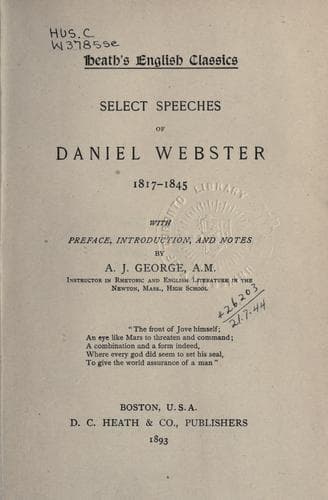
Select Speeches of Daniel Webster, 1817-1845Webster, Daniel
General
Select Speeches of Daniel Webster, 1817-1845
Webster, Daniel
Speeches, addresses, etc., American
finding a man who shall present a more striking realization of the
beautiful conception of D'Aguesseau: "C'est en vain que l'on cherche a
distinguer en lui la personne privée et la personne publique; un même
esprit les anime, un même objet les réunit; l'homme, le père de
famille, le citoyen, tout est en lui consacré à la gloire du magistrat."
Mr. Chief Justice, one may live as a conqueror, a king, or a
magistrate; but he must die as a man. The bed of death brings every
human being to his pure individuality; to the intense contemplation of
that deepest and most solemn of all relations, the relation between the
creature and his Creator. Here it is that fame and renown cannot assist
us; that all external things must fail to aid us; that even friends,
affection, and human love and devotedness, cannot succor us. This
relation, the true foundation of all duty, a relation perceived and
felt by conscience and confirmed by revelation, our illustrious friend,
now deceased, always acknowledged.
He reverenced the Scriptures of truth, honored the pure morality which
they teach, and clung to the hopes of future life which they impart. He
beheld enough in nature, in himself, and in all that can be known of
things seen, to feel assured that there is a Supreme Power, without
whose providence not a sparrow falleth to the ground. To this gracious
being he entrusted himself for time and for eternity; and the last
words of his lips ever heard by mortal ears were a fervent supplication
to his Maker to take him to himself. [2]
Biographical.
First Period: Law and Politics in New Hampshire.
1782 Born at Salisbury, New Hampshire, January 18.
Early Education.
1797 Enters Dartmouth College.
1805 Admitted to the Bar,
1805.
Practises in Boscawen.
1807 Removes to Portsmouth, New Hampshire.
1813 Elected to Congress from Portsmouth.
1814-15 The Hartford Convention.
Second Period: Leader at the Bar and in the Forum.
1816 Removes to Boston, Massachusetts.
1817 "The Defence of the Kennistons."
1818 "The Dartmouth College Case."
1820 Massachusetts Convention.
Third Period: Expounder and Defender of the Constitution.
1827 Elected to the Senate from Massachusetts.
1830 "The Reply to Hayne."
1833 "The Constitution not a Compact between Sovereign States."
1833-34 Removal of the Deposits from the United States Bank.
Rise of the Whig Party.
1835 Nominated to the Presidency by the Whigs of Massachusetts.
1837 Reception in New York.
1839 Visits England.
1840 Presidential Canvass.
1840-43 Secretary of State.
Ashburton Treaty.
Resigns the Department of State.
1844 Re-elected to the Senate from Massachusetts.
1845 "Eulogy on Justice Story."
Annexation of Texas.
1846 Banquet in Philadelphia.
1850 Seventh of March Speech.
Secretary of State under President Fillmore.
1852 Public Reception in Boston.
Last Illness and Death.
Notes.
_DEFENCE OF THE KENNISTONS_
Public-domain text, read in full here on John Shaqi.
Reviews
Reviews
No reviews yet
Be the first to share your thoughts on this work.
Elsewhere in the archive
Join the Discussion
Join the discussion
Sign in to leave a comment or review.
Sign InorCreate an account