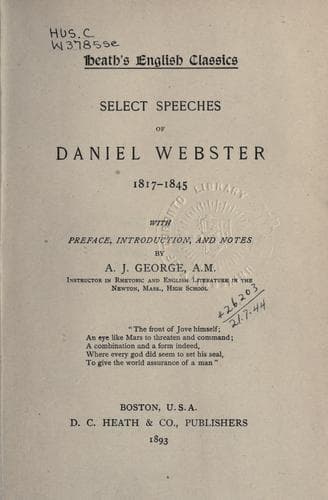
Select Speeches of Daniel Webster, 1817-1845Webster, Daniel
General
Select Speeches of Daniel Webster, 1817-1845
Webster, Daniel
Speeches, addresses, etc., American
[11]L. 29. 2. The first free public school established by law in
Plymouth Colony was in 1670.
[12]P. 111, l. 17. 1. Cf. _Beginnings of New England_, p. 110,
"Founding of Harvard College." Lowell's "Harvard Anniversary."
In 1647 the Colony of Massachusetts Bay passed the law requiring every
town of one hundred families to set up a grammar school which should
prepare youth for the university.
If Mr. Webster by his handling of the Dartmouth College Case founded a
new school of constitutional law, by the Plymouth Oration he founded a
new school of oratory. This field of occasional oratory was a new and
peculiar one for him. He had never before spoken upon a great
historical subject demanding not only wealth of imagination, but the
peculiar quality of mind and heart which unites dignity and depth of
thought with ease and grace of manner. But he was equal to the task.
The simplicity and beauty of the thought, the grand and inspiring
manner of presentation, gave evidence of commanding genius, and gave
Mr. Webster a place in the front rank of orators and stylists.
"I never saw him," says Mr. Ticknor, "when he seemed to me to be more
conscious of his own powers, or to have a more true and natural
enjoyment from their possession."
John Adams, who had heard Pitt and Fox, Burke and Sheridan, says: "It
is the effort of a great mind, richly stored with every species of
information. If there be an American who can read it without tears, I
am not that American. Mr. Burke is no longer entitled to the
praise--the most consummate orator of modern times. What can I say of
what regards myself? To my humble name '_Exegisti monumentum ære
perennius_.' The oration ought to be read at the end of every century."
"It is doubtful," says Edward Everett, "whether any extra-professional
literary effort by a public man has attained equal celebrity."
Cf. Curtis's _Life of Webster_, Ch. IX.; Lodge's _Webster_, Ch. IV.; De
Tocqueville's _Democracy in America_, Vol. I.; Whipple's _American
Literature_, "Webster as a Master of English Style"; Bancroft's
_History of the United States_, Vol. I., Chs. XII., XIII., XIV.;
Burke's _Orations on the American War_, edited by A. J. George; Fiske's
_Beginnings of New England_.
* * * * *
_THE BUNKER HILL MONUMENT._
June, 1825.
As early as 1776, the Massachusetts Lodge of Masons, over which General
Warren had presided, asked the Government of Massachusetts for
permission to take up his remains, which were buried on the hill the
day after the battle, and bury them with the usual solemnities. The
request was granted on condition that the government of the colony
should be permitted to erect a monument to his memory.
Public-domain text, read in full here on John Shaqi.
Reviews
Reviews
No reviews yet
Be the first to share your thoughts on this work.
Elsewhere in the archive
Join the Discussion
Join the discussion
Sign in to leave a comment or review.
Sign InorCreate an account