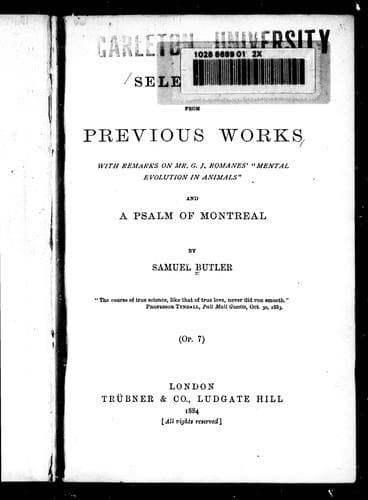
Selections from Previous Works: With Remarks on Romanes' Mental Evolution in Animals, and a Psalm of MontrealButler, Samuel
Philosophy
Selections from Previous Works: With Remarks on Romanes' Mental Evolution in Animals, and a Psalm of Montreal
Butler, Samuel
English literature -- 19th century -- Miscellanea; Romanes, George John, 1848-1894. Mental evolution in animals
If the foregoing be granted, and it be admitted that the unconsciousness
and seeming automatism with which any action may be performed is no bar
to its having a foundation in memory, reason, and at one time consciously
recognised effort--and this I believe to be the chief addition which I
have ventured to make to the theory of Buffon and Dr. Erasmus Darwin--then
the wideness of the difference between the Darwinism of eighty years ago
and the Darwinism of to-day becomes immediately apparent, and it also
becomes apparent, how important and interesting is the issue which is
raised between them.
According to the older Darwinism the lungs are just as purposive as the
corkscrew. They, no less than the corkscrew, are a piece of mechanism
designed and gradually improved upon and perfected by an intelligent
creature for the gratification of its own needs. True there are many
important differences between mechanism which is part of the body, and
mechanism which is no such part, but the differences are such as do not
affect the fact that in each case the result, whether, for example, lungs
or corkscrew, is due to desire, invention, and design.
And now I will ask one more question, which may seem, perhaps, to have
but little importance, but which I find personally interesting. I have
been told by a reviewer, of whom upon the whole I have little reason to
complain, that the theory I put forward in "Life and Habit," and which I
am now again insisting on, is pessimism--pure and simple. I have a very
vague idea what pessimism means, but I should be sorry to believe that I
am a pessimist. Which, I would ask, is the pessimist? He who sees love
of beauty, design, steadfastness of purpose, intelligence, courage, and
every quality to which success has assigned the name of "worth" as having
drawn the pattern of every leaf and organ now and in all past time, or he
who sees nothing in the world of nature but a chapter of accidents and of
forces interacting blindly?
BUFFON--MEMOIR. (CHAPTER VIII. OF EVOLUTION, OLD AND NEW.)
Buffon, says M. Flourens, was born at Montbar, on the 7th of September
1707; he died in Paris, at the Jardin du Roi, on the 16th of April 1788,
aged 81 years. More than fifty of these years, as he used himself to
say, he had passed at his writing-desk. His father was a councillor of
the parliament of Burgundy. His mother was celebrated for her wit, and
Buffon cherished her memory.
He studied at Dijon with much _eclat_, and shortly after leaving became
accidentally acquainted with the Duke of Kingston, a young Englishman of
his own age, who was travelling abroad with a tutor. The three travelled
together in France and Italy, and Buffon then passed some months in
England.
Public-domain text, read in full here on John Shaqi.
Reviews
Reviews
No reviews yet
Be the first to share your thoughts on this work.
Elsewhere in the archive
Join the Discussion
Join the discussion
Sign in to leave a comment or review.
Sign InorCreate an account