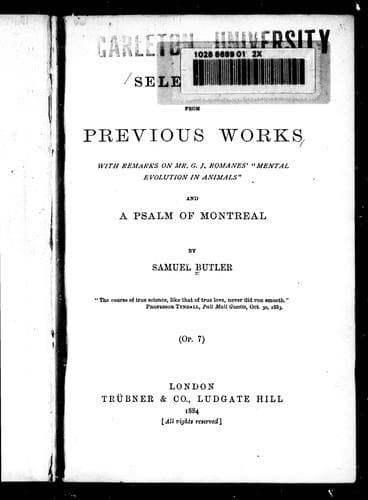
Selections from Previous Works: With Remarks on Romanes' Mental Evolution in Animals, and a Psalm of MontrealButler, Samuel
Philosophy
Selections from Previous Works: With Remarks on Romanes' Mental Evolution in Animals, and a Psalm of Montreal
Butler, Samuel
English literature -- 19th century -- Miscellanea; Romanes, George John, 1848-1894. Mental evolution in animals
"If from the boundless variety which animated nature presents to us,
we choose the body of some animal or even that of man himself to serve
as a model with which to compare the bodies of other organised beings,
we shall find that though all these beings have an individuality of
their own, and are distinguished from one another by differences of
which the gradations are infinitely subtle, there exists at the same
time a primitive and general design which we can follow for a long
way, and the departures from which (_degenerations_) are far more
gentle than those from mere outward resemblance. For not to mention
organs of digestion, circulation, and generation, which are common to
all animals, and without which the animal would cease to be an animal,
and could neither continue to exist nor reproduce itself--there is
none the less even in those very parts which constitute the main
difference in outward appearance, a striking resemblance which carries
with it irresistibly the idea of a single pattern after which all
would appear to have been conceived. The horse, for example--what can
at first sight seem more unlike mankind? Yet when we compare man and
horse point by point and detail by detail, is not our wonder excited
rather by the points of resemblance than of difference that are to be
found between them? Take the skeleton of a man; bend forward the
bones in the region of the pelvis, shorten the thigh bones, and those
of the leg and arm, lengthen those of the feet and hands, run the
joints together, lengthen the jaws, and shorten the frontal bone,
finally, lengthen the spine, and the skeleton will now be that of a
man no longer, but will have become that of a horse--for it is easy to
imagine that in lengthening the spine and the jaws we shall at the
same time have increased the number of the vertebrae, ribs, and teeth.
It is but in the number of these bones, which may be considered
accessory, and by the lengthening, shortening, or mode of attachment
of others, that the skeleton of the horse differs from that of the
human body. . . . We find ribs in man, in all the quadrupeds, in
birds, in fishes, and we may find traces of them as far down as the
turtle, in which they seem still to be sketched out by means of
furrows that are to be found beneath the shell. Let it be remembered
that the foot of the horse, which seems so different from a man's
hand, is, nevertheless, as M. Daubenton has pointed out, composed of
the same bones, and that we have at the end of each of our fingers a
nail corresponding to the hoof of a horse's foot. Judge, then,
whether this hidden resemblance is not more marvellous than any
outward differences--whether this constancy to a single plan of
structure which we may follow from man to the quadrupeds, from the
quadrupeds to the cetacea, from the cetacea to birds, from birds to
Public-domain text, read in full here on John Shaqi.
Reviews
Reviews
No reviews yet
Be the first to share your thoughts on this work.
Elsewhere in the archive
Join the Discussion
Join the discussion
Sign in to leave a comment or review.
Sign InorCreate an account