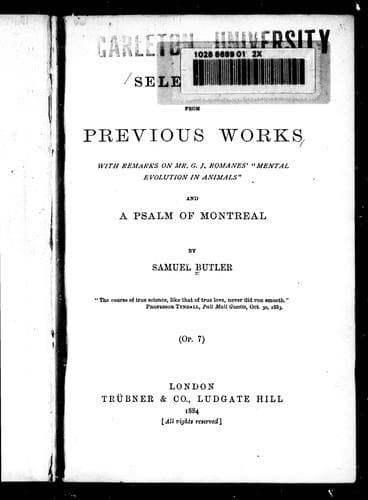
Selections from Previous Works: With Remarks on Romanes' Mental Evolution in Animals, and a Psalm of MontrealButler, Samuel
Philosophy
Selections from Previous Works: With Remarks on Romanes' Mental Evolution in Animals, and a Psalm of Montreal
Butler, Samuel
English literature -- 19th century -- Miscellanea; Romanes, George John, 1848-1894. Mental evolution in animals
"The essential characteristics of every animal have been conserved
without alteration in their most important parts. . . . The
individuals of each genus still represent the same forms as they did
in the earliest ages, especially in the case of the larger animals"
(so that the generic forms even of the larger animals prove not to be
the same, but only "especially" the same as in the earliest ages).
{177b}
This transparently illogical position is maintained ostensibly from first
to last, much in the same spirit as in the two foregoing passages,
written at intervals of thirteen years. But they are to be read by the
light of the earlier one--placed as a lantern to the wary upon the
threshold of his work in 1753--to the effect that a single,
well-substantiated case of degeneration would make it conceivable that
all living beings were descended from but one common ancestor. If after
having led up to this by a remorseless logic, a man is found five-and-
twenty years later still substantiating cases of degeneration, as he has
been substantiating them unceasingly in thirty quartos during the whole
interval, there should be little question how seriously we are to take
him when he wishes us to stop short of the conclusions he has told us we
ought to draw from the premises that he has made it the business of his
life to establish--especially when we know that he has a Sorbonne to keep
a sharp eye upon him.
I believe that if the reader will bear in mind the twofold, serious and
ironical, character of Buffon's work he will understand it, and feel an
admiration for it which will grow continually greater and greater the
more he studies it, otherwise he will miss the whole point.
Buffon on one of the early pages of his first volume protested against
the introduction of either "_plaisanterie_" or "_equivoque_" (p. 25) into
a serious work. But I have observed that there is an unconscious irony
in most disclaimers of this nature. When a writer begins by saying that
he has "an ineradicable tendency to make things clear," we may infer that
we are going to be puzzled; so when he shows that he is haunted by a
sense of the impropriety of allowing humour to intrude into his work, we
may hope to be amused as well as interested. As showing how far the
objection to humour which he expressed upon his twenty-fifth page
succeeded in carrying him safely over his twenty-sixth and
twenty-seventh, I will quote the following, which begins on page twenty-
six:--
Public-domain text, read in full here on John Shaqi.
Reviews
Reviews
No reviews yet
Be the first to share your thoughts on this work.
Elsewhere in the archive
Join the Discussion
Join the discussion
Sign in to leave a comment or review.
Sign InorCreate an account