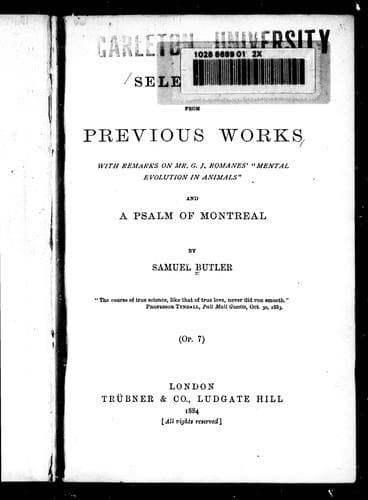
Selections from Previous Works: With Remarks on Romanes' Mental Evolution in Animals, and a Psalm of MontrealButler, Samuel
Philosophy
Selections from Previous Works: With Remarks on Romanes' Mental Evolution in Animals, and a Psalm of Montreal
Butler, Samuel
English literature -- 19th century -- Miscellanea; Romanes, George John, 1848-1894. Mental evolution in animals
I will deal with these two last points briefly first. As regards the
evidence in support of the theory that instinct and growth are due to a
rapid unconscious memory of past experiences and developments in the
persons of the ancestors of the living form in which they appear, I must
refer my readers to Life and Habit, and to the translation of Professor
Hering's lecture given in Chapter VI. of Unconscious Memory. I will only
repeat here that a chrysalis, we will say, is as much one and the same
person with the chrysalis of its preceding generation, as this last is
one and the same person with the egg or caterpillar from which it sprang.
You cannot deny personal identity between two successive generations
without sooner or later denying it during the successive stages in the
single life of what we call one individual; nor can you admit personal
identity through the stages of a long and varied life (embryonic and post-
natal) without admitting it to endure through an endless series of
generations.
The personal identity of successive generations being admitted, the
possibility of the second of two generations remembering what happened to
it in the first is obvious. The _a priori_ objection, therefore, is
removed, and the question becomes one of fact--does the offspring act as
if it remembered?
The answer to this question is not only that it does so act, but that it
is not possible to account for either its development or its early
instinctive actions upon any other hypothesis than that of its
remembering, and remembering exceedingly well.
The only alternative is to declare with Von Hartmann that a living being
may display a vast and varied information concerning all manner of
details, and be able to perform most intricate operations, independently
of experience and practice. Once admit knowledge independent of
experience, and farewell to sober sense and reason from that moment.
Firstly, then, we show that offspring has had every facility for
remembering; secondly, that it shows every appearance of having
remembered; thirdly, that no other hypothesis except memory can be
brought forward, so as to account for the phenomena of instinct and
heredity generally, which is not easily reducible to an absurdity. Beyond
this we do not care to go, and must allow those to differ from us who
require further evidence.
Public-domain text, read in full here on John Shaqi.
Reviews
Reviews
No reviews yet
Be the first to share your thoughts on this work.
Elsewhere in the archive
Join the Discussion
Join the discussion
Sign in to leave a comment or review.
Sign InorCreate an account