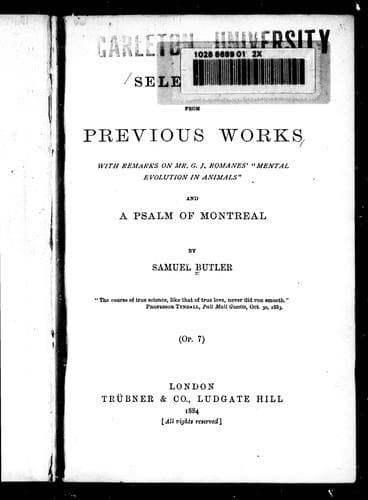
Selections from Previous Works: With Remarks on Romanes' Mental Evolution in Animals, and a Psalm of MontrealButler, Samuel
Philosophy
Selections from Previous Works: With Remarks on Romanes' Mental Evolution in Animals, and a Psalm of Montreal
Butler, Samuel
English literature -- 19th century -- Miscellanea; Romanes, George John, 1848-1894. Mental evolution in animals
The fact, therefore, that on each repetition of the action there is one
memory more than on the last but one, and that this memory is slightly
different from its predecessor, is seen to be an inherent and, _ex
hypothesi_, necessarily disturbing factor in all habitual action--and the
life of an organism should, as has been sufficiently insisted on, be
regarded as the habitual action of a single individual, namely, of the
organism itself, and of its ancestors. This is the key to accumulation
of improvement, whether in the arts which we assiduously practise during
our single life, or in the structures and instincts of successive
generations. The memory does not complete a true circle, but is, as it
were, a spiral slightly divergent therefrom. It is no longer a perfectly
circulating decimal. Where, on the other hand, there is no memory of a
like present, where, in fact, the memory is not, so to speak, spiral,
there is no accumulation of improvement. The effect of any variation is
not transmitted, and is not thus pregnant of still further change.
As regards the second of the two classes of actions above referred
to--those, namely which are not recurrent or habitual, _and at no point
of which is there a memory of a past present like the one which is
present now_--there will have been no accumulation of strong and well-
knit memory as regards the action as a whole, but action, if taken at
all, will be taken upon disjointed fragments of individual actions (our
own and those of other people) pieced together with a result more or less
satisfactory according to circumstances.
But it does not follow that the action of two people who have had
tolerably similar antecedents and are placed in tolerably similar
circumstances should be more unlike each other in this second case than
in the first. On the contrary, nothing is more common than to observe
the same kind of people making the same kind of mistake when placed for
the first time in the same kind of new circumstances. I did not say that
there would be no sameness of action without memory of a like present.
There may be sameness of action proceeding from a memory, conscious or
unconscious, of like antecedents, and _a presence only of like presents
without recollection of the same_.
Public-domain text, read in full here on John Shaqi.
Reviews
Reviews
No reviews yet
Be the first to share your thoughts on this work.
Elsewhere in the archive
Join the Discussion
Join the discussion
Sign in to leave a comment or review.
Sign InorCreate an account