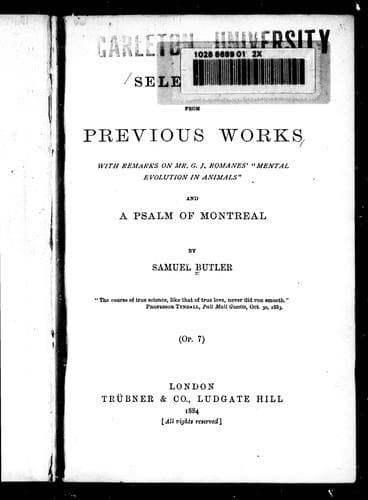
Selections from Previous Works: With Remarks on Romanes' Mental Evolution in Animals, and a Psalm of MontrealButler, Samuel
Philosophy
Selections from Previous Works: With Remarks on Romanes' Mental Evolution in Animals, and a Psalm of Montreal
Butler, Samuel
English literature -- 19th century -- Miscellanea; Romanes, George John, 1848-1894. Mental evolution in animals
The attempt to get a higher form of a life from a lower one is in
accordance with our observation and experience. It is therefore proper
to be believed. The attempt to get it from that which has absolutely no
life is like trying to get something out of nothing. The millionth part
of a farthing put out to interest at ten per cent. will in five hundred
years become over a million pounds, and so long as we have any millionth
of a millionth of the farthing to start with, our getting as many million
pounds as we have a fancy for is only a question of time, but without the
initial millionth of a millionth of a millionth part, we shall get no
increment whatever. A little leaven will leaven the whole lump, but
there must be _some_ leaven.
We should endeavour to see the so-called inorganic as living, in respect
of the qualities it has in common with the organic, rather than the
organic as non-living in respect of the qualities it has in common with
the inorganic. True, it would be hard to place one's self on the same
moral platform as a stone, but this is not necessary; it is enough that
we should feel the stone to have a moral platform of its own, though that
platform embraces little more than a profound respect for the laws of
gravitation, chemical affinity, &c. As for the difficulty of conceiving
a body as living that has not got a reproductive system--we should
remember that neuter insects are living but are believed to have no
reproductive system. Again, we should bear in mind that mere
assimilation involves all the essentials of reproduction, and that both
air and water possess this power in a very high degree. The essence of a
reproductive system, then, is found low down in the scheme of nature.
At present our leading men of science are in this difficulty; on the one
hand their experiments and their theories alike teach them that
spontaneous generation ought not to be accepted; on the other, they must
have an origin for the life of the living forms, which, by their own
theory, have been evolved, and they can at present get this origin in no
other way than by _Deus ex machina_ method, which they reject as
unproved, or spontaneous generation of living from non-living matter,
which is no less foreign to their experience. As a general rule, they
prefer the latter alternative. So Professor Tyndall, in his celebrated
article (_Nineteenth Century_, November 1878), wrote:--
"The theory of evolution in its complete form involves the assumption
that at some period or other of the earth's history there occurred what
would be now called 'spontaneous generation.'" {217} And so Professor
Huxley--
"It is argued that a belief in abiogenesis is a necessary corollary
from the doctrine of Evolution. This may be" [which I submit is
equivalent here to "is"] "true of the occurrence of abiogenesis at
some time." {218}
Public-domain text, read in full here on John Shaqi.
Reviews
Reviews
No reviews yet
Be the first to share your thoughts on this work.
Elsewhere in the archive
Join the Discussion
Join the discussion
Sign in to leave a comment or review.
Sign InorCreate an account