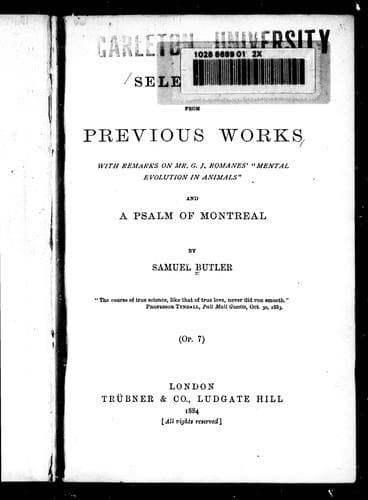
Selections from Previous Works: With Remarks on Romanes' Mental Evolution in Animals, and a Psalm of MontrealButler, Samuel
Philosophy
Selections from Previous Works: With Remarks on Romanes' Mental Evolution in Animals, and a Psalm of Montreal
Butler, Samuel
English literature -- 19th century -- Miscellanea; Romanes, George John, 1848-1894. Mental evolution in animals
"The hypothesis of Lamarck--that progressive changes in species have
been produced by the attempts of animals to increase the development
of their own organs and thus modify their structure and habits--has
been repeatedly and easily refuted by all writers on the subject of
varieties and species, . . . but the view here developed renders such
a hypothesis quite unnecessary . . . The powerful retractile talons
of the falcon and the cat tribes have not been produced or increased
by the volition of those animals, . . . neither did the giraffe
acquire its long neck by desiring to reach the foliage of the more
lofty shrubs, and constantly stretching its neck for this purpose, but
because any varieties which occurred among its antitypes with a longer
neck than usual _at once secured a fresh range of pasture over the
same ground as their short-necked companions_, _and on the first
scarcity of food were thereby enabled to outlive them_" (italics in
original). {223a}
This is absolutely the neo-Darwin doctrine, and a denial of the mainly
fortuitous character of the variations in animal and vegetable forms cuts
at its root. That Mr. Wallace, after years of reflection, still adhered
to this view, is proved by his heading a reprint of the paragraph just
quoted from {223b} with the words "Lamarck's hypothesis very different
from that now advanced;" nor do any of his more recent works show that he
has modified his opinion. It should be noted that Mr. Wallace does not
call his work Contributions to the Theory of Evolution, but to that of
Natural Selection.
Mr. Darwin, with characteristic caution, only commits himself to saying
that Mr. Wallace has arrived at _almost_ (italics mine) the same general
conclusions as he, Mr. Darwin, has done; {223c} but he still, as in 1859,
declares that it would be "a serious error to suppose that the greater
number of instincts have been acquired by habit in one generation and
then transmitted by inheritance to succeeding generations," {223d} and he
still comprehensively condemns the "well-known doctrine of inherited
habit, as advanced by Lamarck." {224}
Public-domain text, read in full here on John Shaqi.
Reviews
Reviews
No reviews yet
Be the first to share your thoughts on this work.
Elsewhere in the archive
Join the Discussion
Join the discussion
Sign in to leave a comment or review.
Sign InorCreate an account