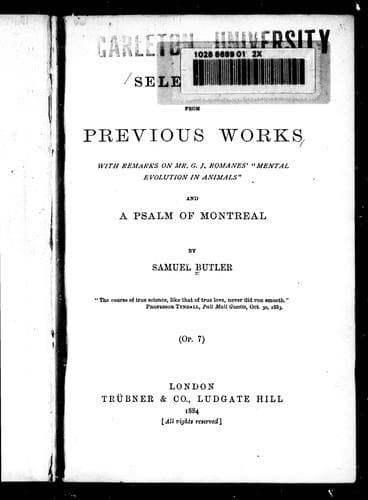
Selections from Previous Works: With Remarks on Romanes' Mental Evolution in Animals, and a Psalm of MontrealButler, Samuel
Philosophy
Selections from Previous Works: With Remarks on Romanes' Mental Evolution in Animals, and a Psalm of Montreal
Butler, Samuel
English literature -- 19th century -- Miscellanea; Romanes, George John, 1848-1894. Mental evolution in animals
This is easy; it tells people how they may test any action so as to know
what they ought to call it; it leaves well alone by avoiding all such
debatable matters as reflex action, consciousness, intelligence, purpose,
knowledge of purpose, &c.; it both introduces the feature of inheritance
which is the one mainly distinguishing instinctive from so-called
intelligent actions, and shows the manner in which these last pass into
the first, that is to say, by way of memory and habitual repetition;
finally it points the fact that the new generation is not to be looked
upon as a new thing, but (as Dr. Erasmus Darwin long since said {241}) as
"a branch or elongation" of the one immediately preceding it.
But then to have said this would have made it too plain that Mr. Romanes
was following some one else. Mr. Romanes should remember that no one
would mind how much he took if he would only take it well. But this is
what those who take without due acknowledgment never do.
In Mr. Darwin's case it is hardly possible to exaggerate the waste of
time, money, and trouble that has been caused by his not having been
content to appear as descending with modification like other people from
those who went before him. It will take years to get the evolution
theory out of the mess in which Mr. Darwin has left it. He was heir to a
discredited truth; he left behind him an accredited fallacy. Mr.
Romanes, if he is not stopped in time, will get the theory connecting
heredity and memory into just such another muddle as Mr. Darwin has got
Evolution, for surely the writer who can talk about "_heredity being able
to work up_ the faculty of homing into the instinct of migration," {242a}
or of "the principle of (natural) selection combining with that of
lapsing intelligence to the formation of a joint result," {242b} is
little likely to depart from the usual methods of scientific procedure
with advantage either to himself or any one else. Fortunately Mr.
Romanes is not Mr. Darwin, and though he has certainly got Mr. Darwin's
mantle, and got it very much too, it will not on Mr. Romanes' shoulders
hide a good deal that people were not going to observe too closely while
Mr. Darwin wore it.
REMARKS ON MR. ROMANES' MENTAL EVOLUTION IN ANIMALS--(_concluded_).
I gather that in the end the late Mr. Darwin himself admitted the
soundness of the view which the reader will have found insisted upon in
the extracts from my earlier books given in this volume. Mr. Romanes
quotes a letter written by Mr. Darwin in the last year of his life, in
which he speaks of an intelligent action gradually becoming
"_instinctive_, _i.e._, _memory transmitted from one generation to
another_." {243a}
Briefly, the stages of Mr. Darwin's opinion upon the subject of
hereditary memory are as follows:--
Public-domain text, read in full here on John Shaqi.
Selections from Previous Works: With Remarks on Romanes' Mental Evolution in Animals, and a Psalm of Montreal — John Shaqi
Reviews
Reviews
No reviews yet
Be the first to share your thoughts on this work.
Elsewhere in the archive
Join the Discussion
Join the discussion
Sign in to leave a comment or review.
Sign InorCreate an account