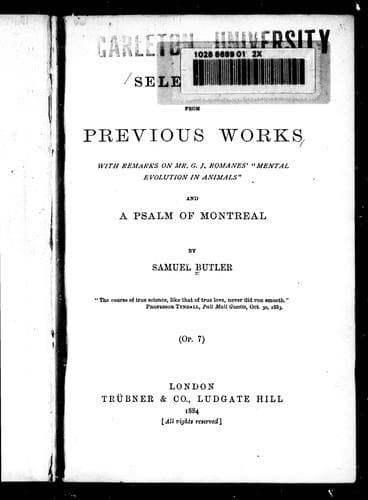
Selections from Previous Works: With Remarks on Romanes' Mental Evolution in Animals, and a Psalm of MontrealButler, Samuel
Philosophy
Selections from Previous Works: With Remarks on Romanes' Mental Evolution in Animals, and a Psalm of Montreal
Butler, Samuel
English literature -- 19th century -- Miscellanea; Romanes, George John, 1848-1894. Mental evolution in animals
Mr. Romanes proceeds to inform me personally that the reference to
"Nature" in his proof "originally indicated another writer who had
independently advanced the same theory as that of Canon Kingsley." After
this I have a right to ask him to tell me who the writer is, and where I
shall find what he said. I ask this, and at my earliest opportunity will
do my best to give this writer, too, the credit he doubtless deserves.
I have never professed to be the originator of the theory connecting
heredity with memory. I knew I knew so little that I was in great
trepidation when I wrote all the earlier chapters of "Life and Habit." I
put them paradoxically, because I did not dare to put them otherwise. As
the book went on, I saw I was on firm ground, and the paradox was
dropped. When I found what Professor Hering had done, I put him forward
as best I could at once. I then learned German, and translated him,
giving his words in full in "Unconscious Memory;" since then I have
always spoken of the theory as Professor Hering's.
Mr. Romanes says that "the theory in question forms the backbone of all
the previous literature on instinct by the above-named writers (not to
mention their numerous followers) and is by all of them elaborately
stated as clearly as any theory can be stated in words." Few except Mr.
Romanes will say this. I grant it ought to have formed the backbone "of
all previous literature on instinct by the above-named writers," but when
I wrote "Life and Habit" it was not understood to form it. If it had
been, I should not have found it necessary to come before the public this
fourth time during the last seven years to insist upon it. Of course the
theory is not new--it was in the air and bound to come; but when it came,
it came through Professor Hering of Prague, and not through those who,
great as are the services they have rendered, still did not render this
particular one of making memory the keystone of their system. Mr.
Romanes now says: "Why, of course, that's what they were meaning all the
time." Perhaps they were, but they did not say so, and
others--conspicuously Mr. Romanes himself--did not understand them to be
meaning what he now discovers that they meant. When Mr. Romanes attacked
me in _Nature_, January 27, 1881, he said I had "been anticipated by
Professor Hering," but he evidently did not understand that any one else
had anticipated me; and far from holding, as he now does, that "the
theory in question forms the backbone of all the previous" writers on
instinct, and "is by all of them elaborately stated as clearly as any
theory can be stated in words," he said (in a passage already quoted)
that it was "interesting, if advanced merely as an illustration, but to
imagine that it maintains any truth of profound significance, or that it
can possibly be fraught with any benefit to science, is absurd."
Considering how recently Mr. Romanes wrote the words just quoted, he has
soon forgotten them.
Public-domain text, read in full here on John Shaqi.
Reviews
Reviews
No reviews yet
Be the first to share your thoughts on this work.
Elsewhere in the archive
Join the Discussion
Join the discussion
Sign in to leave a comment or review.
Sign InorCreate an account