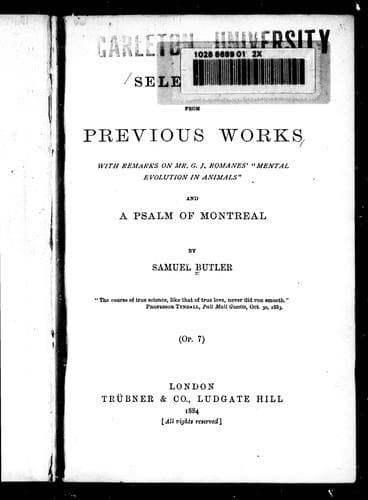
Selections from Previous Works: With Remarks on Romanes' Mental Evolution in Animals, and a Psalm of MontrealButler, Samuel
Philosophy
Selections from Previous Works: With Remarks on Romanes' Mental Evolution in Animals, and a Psalm of Montreal
Butler, Samuel
English literature -- 19th century -- Miscellanea; Romanes, George John, 1848-1894. Mental evolution in animals
* * * * *
The little objects looking like sentry-boxes that go all round Prato
Church contain rough modern frescoes representing, if I remember rightly,
the events attendant upon the crucifixion. These are on a small scale
what the chapels on the sacred mountain of Varallo are on a large one.
Small single oratories are scattered about all over the Canton Ticino,
and indeed everywhere in North Italy, by the road-side, at all halting-
places, and especially at the crest of any more marked ascent, where the
tired wayfarer, probably heavy laden, might be inclined to say a naughty
word or two if not checked. The people like them, and miss them when
they come to England. They sometimes do what the lower animals do in
confinement when precluded from habits they are accustomed to, and put up
with strange makeshifts by way of substitute. I once saw a poor Ticinese
woman kneeling in prayer before a dentist's show-case in the Hampstead
Road; she doubtless mistook the teeth for the relics of some saint. I am
afraid she was a little like a hen sitting upon a chalk egg, but she
seemed quite contented.
Which of us, indeed, does not sit contentedly enough upon chalk eggs at
times? And what would life be but for the power to do so? We do not
sufficiently realise the part which illusion has played in our
development. One of the prime requisites for evolution is a certain
power for adaptation to varying circumstances, that is to say, of
plasticity, bodily and mental. But the power of adaptation is mainly
dependent on the power of thinking certain new things sufficiently like
certain others to which we have been accustomed for us not to be too much
incommoded by the change--upon the power, in fact, of mistaking the new
for the old. The power of fusing ideas (and through ideas, structures)
depends upon the power of _con_fusing them; the power to confuse ideas
that are not very unlike, and that are presented to us in immediate
sequence, is mainly due to the fact of the impetus, so to speak, which
the mind has upon it. It is this which bars association from sticking to
the letter of its bond; for we are in a hurry to jump to a conclusion on
the first show of plausible pretext, and cut association's statement of
claim short by taking it as read before we have got through half of it.
We "get it into our notes, in fact," as Mr. Justice Stareleigh did in
Pickwick, and having got it once in, we are not going to get it out
again. This breeds fusion and confusion, and from this there come new
developments.
Public-domain text, read in full here on John Shaqi.
Reviews
Reviews
No reviews yet
Be the first to share your thoughts on this work.
Elsewhere in the archive
Join the Discussion
Join the discussion
Sign in to leave a comment or review.
Sign InorCreate an account