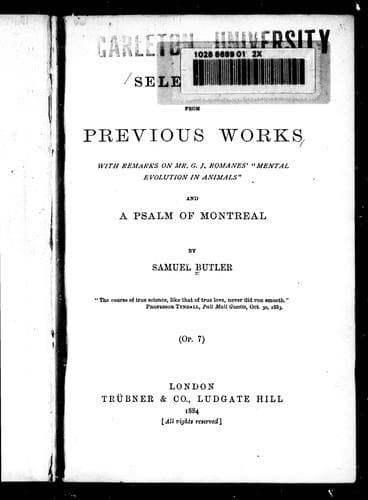
Selections from Previous Works: With Remarks on Romanes' Mental Evolution in Animals, and a Psalm of MontrealButler, Samuel
Philosophy
Selections from Previous Works: With Remarks on Romanes' Mental Evolution in Animals, and a Psalm of Montreal
Butler, Samuel
English literature -- 19th century -- Miscellanea; Romanes, George John, 1848-1894. Mental evolution in animals
At the close of the tenth century, when Otho III. was Emperor of Germany,
a certain Hugh de Montboissier, a noble of Auvergne, commonly called
"Hugh the Unsewn" (_lo sdruscito_), was commanded by the Pope to found a
monastery in expiation of some grave offence. He chose for his site the
summit of the Monte Pirchiriano in the valley of Susa, being attracted
partly by the fame of a church already built there by a recluse of
Ravenna, Giovanni Vincenzo by name, and partly by the striking nature of
the situation. Hugh de Montboissier, when returning from Rome to France
with Isengarde his wife, would, as a matter of course, pass through the
valley of Susa. The two--perhaps when stopping to dine at S.
Ambrogio--would look up and observe the church founded by Giovannia
Vincenzo: they had got to build a monastery somewhere; it would very
likely, therefore, occur to them that they could not perpetuate their
names better than by choosing this site, which was on a much-travelled
road, and on which a fine building would show to advantage. If my view
is correct, we have here an illustration of a fact which is continually
observable--namely, that all things which come to much, whether they be
books, buildings, pictures, music, or living beings, are begotten of
others of their own kind. It is always the most successful, like Handel
and Shakespeare, who owe most to their forerunners, in spite of the
modifications with which their works descend.
Giovanni Vincenzo had built his church about the year 987. It is
maintained by some that he had been bishop of Ravenna, but Clareta gives
sufficient reason for thinking otherwise. In the "Cronaca Clusina" it is
said that he had for some years previously lived as a recluse on the
Monte Caprasio, to the north of the present Monte Pirchiriano; but that
one night he had a vision, in which he saw the summit of Monte
Pirchiriano enveloped in heaven-descended flames, and on this founded a
church there, and dedicated it to S. Michael. This is the origin of the
name Pirchiriano, which means [Greek text], or the Lord's fire.
Public-domain text, read in full here on John Shaqi.
Reviews
Reviews
No reviews yet
Be the first to share your thoughts on this work.
Elsewhere in the archive
Join the Discussion
Join the discussion
Sign in to leave a comment or review.
Sign InorCreate an account