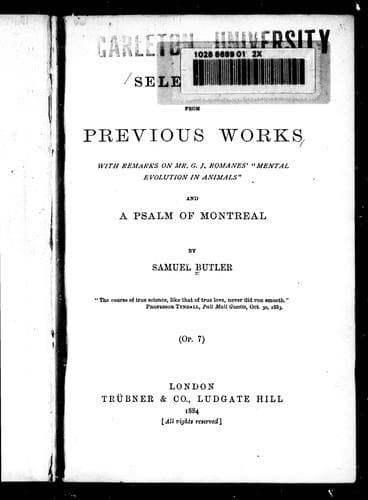
Selections from Previous Works: With Remarks on Romanes' Mental Evolution in Animals, and a Psalm of MontrealButler, Samuel
Philosophy
Selections from Previous Works: With Remarks on Romanes' Mental Evolution in Animals, and a Psalm of Montreal
Butler, Samuel
English literature -- 19th century -- Miscellanea; Romanes, George John, 1848-1894. Mental evolution in animals
The one thing, he said, which shocked him with the English, was the
manner in which they went about distributing tracts upon the Continent. I
said no one could deplore the practice more profoundly than myself, but
that there were stupid and conceited people in every country, who would
insist upon thrusting their opinions upon people who did not want them.
He replied that the Italians travelled not a little in England, but that
he was sure not one of them would dream of offering Catholic tracts to
people, for example, in the streets of London. Certainly I have never
seen an Italian to be guilty of such rudeness. It seems to me that it is
not only toleration that is a duty; we ought to go beyond this now; we
should conform, when we are among a sufficient number of those who would
not understand our refusal to do so; any other course is to attach too
much importance at once to our own opinions and to those of our
opponents. By all means let a man stand by his convictions when the
occasion requires, but let him reserve his strength, unless it is
imperatively called for. Do not let him exaggerate trifles, and let him
remember that everything is a trifle in comparison with the not giving
offence to a large number of kindly, simple-minded people. Evolution, as
we all know, is the great doctrine of modern times; the very essence of
evolution consists in the not shocking anything too violently, but
enabling it to mistake a new action for an old one, without "making
believe" too much.
One day when I was eating my lunch near a fountain, there came up a
moody, meditative hen, crooning plaintively after her wont. I threw her
a crumb of bread while she was still a good way off, and then threw more,
getting her to come a little closer and a little closer each time; at
last she actually took a piece from my hand. She did not quite like it,
but she did it. "A very little at a time," this is the evolution
principle; and if we wish those who differ from us to understand us, it
is the only method to proceed upon. I have sometimes thought that some
of my friends among the priests have been treating me as I treated the
meditative hen. But what of that? They will not kill and eat me, nor
take my eggs. Whatever, therefore, promotes a more friendly feeling
between us must be pure gain.
* * * * *
Sometimes priests say things, as a matter of course, which would make any
English clergyman's hair stand on end. At one town there is a remarkable
fourteenth-century bridge, commonly known as "The Devil's Bridge." I was
sketching near this when a jolly old priest with a red nose came up and
began a conversation with me. He was evidently a popular character, for
every one who passed greeted him. He told me that the devil did not
really build the bridge. I said I presumed not, for he was not in the
habit of spending his time so well.
"I wish he had built it," said my friend; "for then perhaps he would
build us some more."
Public-domain text, read in full here on John Shaqi.
Reviews
Reviews
No reviews yet
Be the first to share your thoughts on this work.
Elsewhere in the archive
Join the Discussion
Join the discussion
Sign in to leave a comment or review.
Sign InorCreate an account