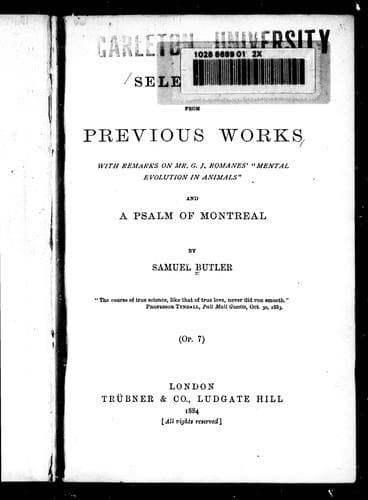
Selections from Previous Works: With Remarks on Romanes' Mental Evolution in Animals, and a Psalm of MontrealButler, Samuel
Philosophy
Selections from Previous Works: With Remarks on Romanes' Mental Evolution in Animals, and a Psalm of Montreal
Butler, Samuel
English literature -- 19th century -- Miscellanea; Romanes, George John, 1848-1894. Mental evolution in animals
Lord Beaconsfield sent Lothair to Oxford; it is with great pleasure that
I see he did not send Endymion. My friend Jones called my attention to
this, and we noted that the growth observable throughout Lord
Beaconsfield's life was continued to the end. He was one of those who,
no matter how long he lived, would have been always growing: this is what
makes his later novels so much better than those of Thackeray or Dickens.
There was something of the child about him to the last. Earnestness was
his greatest danger, but if he did not quite overcome it (as who indeed
can? It is the last enemy that shall be subdued), he managed to veil it
with a fair amount of success. As for Endymion, of course if Lord
Beaconsfield had thought Oxford would be good for him, he could, as Jones
pointed out to me, just as well have killed Mr. Ferrars a year or two
later. We feel satisfied, therefore, that Endymion's exclusion from a
university was carefully considered, and are glad.
I will not say that priggishness is absolutely unknown among the North
Italians; sometimes one comes upon a young Italian who wants to learn
German, but not often. Priggism, or whatever the substantive is, is as
essentially a Teutonic vice as holiness is a Semitic characteristic; and
if an Italian happens to be a prig, he will, like Tacitus, invariably
show a hankering after German institutions. The idea, however, that the
Italians were ever a finer people than they are now, will not pass muster
with those who knew them.
At the same time, there can be no doubt that modern Italian art is in
many respects as bad as it was once good. I will confine myself to
painting only. The modern Italian painters, with very few exceptions,
paint as badly as we do, or even worse, and their motives are as poor as
is their painting. At an exhibition of modern Italian pictures, I
generally feel that there is hardly a picture on the walls but is a
sham--that is to say, painted not from love of this particular subject
and an irresistible desire to paint it, but from a wish to paint an
academy picture, and win money or applause.
The last rays of the sunset of genuine art are to be found in the votive
pictures at Locarno or Oropa, and in many a wayside chapel. In these,
religious art still lingers as a living language, however rudely spoken.
In these alone is the story told, not as in the Latin and Greek verses of
the scholar, who thinks he has succeeded best when he has most concealed
his natural manner of expressing himself, but by one who knows what he
wants to say, and says it in his mother-tongue, shortly, and without
caring whether or not his words are in accordance with academic rules. I
regret to see photography being introduced for votive purposes, and also
to detect in some places a disposition on the part of the authorities to
be a little ashamed of these pictures and to place them rather out of
sight.
Public-domain text, read in full here on John Shaqi.
Reviews
Reviews
No reviews yet
Be the first to share your thoughts on this work.
Elsewhere in the archive
Join the Discussion
Join the discussion
Sign in to leave a comment or review.
Sign InorCreate an account