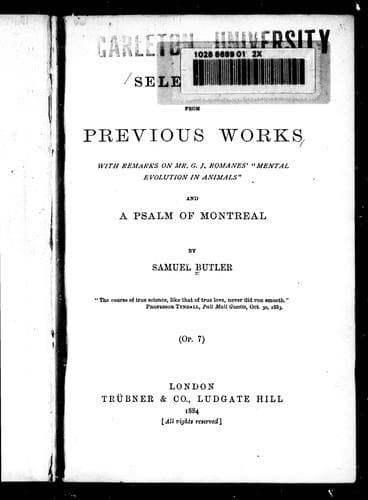
Selections from Previous Works: With Remarks on Romanes' Mental Evolution in Animals, and a Psalm of MontrealButler, Samuel
Philosophy
Selections from Previous Works: With Remarks on Romanes' Mental Evolution in Animals, and a Psalm of Montreal
Butler, Samuel
English literature -- 19th century -- Miscellanea; Romanes, George John, 1848-1894. Mental evolution in animals
Any man who can write, can draw to a not inconsiderable extent. Look at
the Bayeux tapestry; yet Matilda probably never had a drawing lesson in
her life. See how well prisoner after prisoner in the Tower of London
has cut out this or that in the stone of his prison wall, without, in all
probability, having ever tried his hand at drawing before. Look at my
friend Jones, who has several illustrations in this book. {294} The
first year he went abroad with me he could hardly draw at all. He was no
year away from England more than three weeks. How did he learn? On the
old principle, if I am not mistaken. The old principle was for a man to
be doing something which he was pretty strongly bent on doing, and to get
a much younger one to help him. The younger paid nothing for
instruction, but the elder took the work, as long as the relation of
master and pupil existed between them. I, then, was mailing
illustrations for this book, and got Jones to help me. I let him see
what I was doing, and derive an idea of the sort of thing I wanted, and
then left him alone--beyond giving him the same kind of small criticism
that I expected from himself--but I appropriated his work. That is the
way to teach, and the result was that in an incredibly short time Jones
could draw. The taking the work is a _sine qua non_. If I had not been
going to have his work, Jones, in spite of all his quickness, would
probably have been rather slower in learning to draw. Being paid in
money is nothing like so good.
This is the system of apprenticeship _versus_ the academic system. The
academic system consists in giving people the rules for doing things. The
apprenticeship system consists in letting them do it, with just a trifle
of supervision. "For all a rhetorician's rules," says my great namesake,
"teach nothing but, to name his tools;" and academic rules generally are
much the same as the rhetorician's. Some men can pass through academies
unscathed, but they are very few, and in the main the academic influence
is a baleful one, whether exerted in a university or a school. While
young men at universities are being prepared for their entry into life,
their rivals have already entered it. The most university and
examination ridden people in the world are the Chinese, and they are the
least progressive.
Public-domain text, read in full here on John Shaqi.
Reviews
Reviews
No reviews yet
Be the first to share your thoughts on this work.
Elsewhere in the archive
Join the Discussion
Join the discussion
Sign in to leave a comment or review.
Sign InorCreate an account