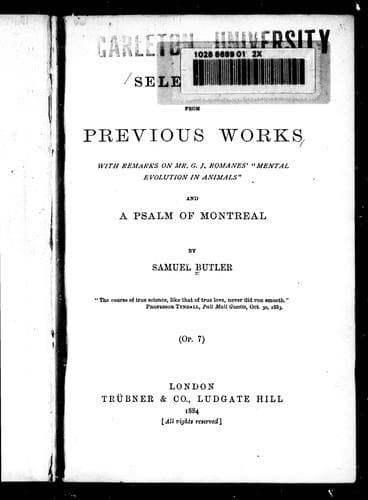
Selections from Previous Works: With Remarks on Romanes' Mental Evolution in Animals, and a Psalm of MontrealButler, Samuel
Philosophy
Selections from Previous Works: With Remarks on Romanes' Mental Evolution in Animals, and a Psalm of Montreal
Butler, Samuel
English literature -- 19th century -- Miscellanea; Romanes, George John, 1848-1894. Mental evolution in animals
There were many fewer people at Graglia than at Oropa, and they were
richer. I did not see any poor about, but I may have been there during a
slack time. An impression was left upon me, though I cannot say whether
it was well or ill founded, as though there were a tacit understanding
between the establishments at Oropa and Graglia that the one was to adapt
itself to the poorer, and the other to the richer classes of society; and
this not from any sordid motive, but from a recognition of the fact that
any great amount of intermixture between the poor and the rich is not
found satisfactory to either one or the other. Any wide difference in
fortune does practically amount to a specific difference, which renders
the members of either species more or less suspicious of those of the
other, and seldom fertile _inter se_. The well-to-do working-man can
help his poorer friends better than we can. If an educated man has money
to spare, he will apply it better in helping poor educated people than
those who are more strictly called the poor. As long as the world is
progressing, wide class distinctions are inevitable; their discontinuance
will be a sign that equilibrium has been reached. Then human
civilisation will become as stationary as that of ants and bees. Some
may say it will be very sad when this is so; others, that it will be a
good thing; in truth, it is good either way, for progress and equilibrium
have each of them advantages and disadvantages which make it impossible
to assign superiority to either; but in both cases the good greatly
overbalances the evil; for in both the great majority will be fairly well
contented, and would hate to live under any other system.
Equilibrium, if it is ever reached, will be attained very slowly, and the
importance of any change in a system depends entirely upon the rate at
which it is made. No amount of change shocks--or, in other words, is
important--if it is made sufficiently slowly, while hardly any change is
too small to shock if it is made suddenly. We may go down a ladder of
ten thousand feet in height if we do so step by step, while a sudden fall
of six or seven feet may kill us. The importance, therefore, does not
lie in the change, but in the abruptness of its introduction. Nothing is
absolutely important or absolutely unimportant; absolutely good, or
absolutely bad.
Public-domain text, read in full here on John Shaqi.
Reviews
Reviews
No reviews yet
Be the first to share your thoughts on this work.
Elsewhere in the archive
Join the Discussion
Join the discussion
Sign in to leave a comment or review.
Sign InorCreate an account