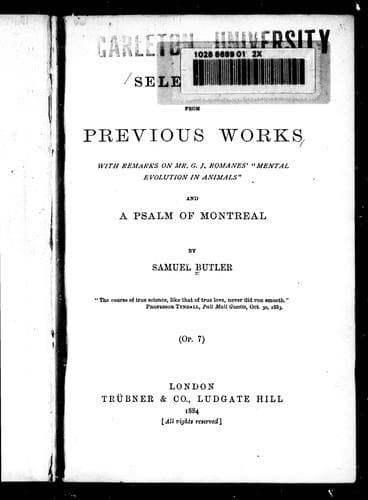
Selections from Previous Works: With Remarks on Romanes' Mental Evolution in Animals, and a Psalm of MontrealButler, Samuel
Philosophy
Selections from Previous Works: With Remarks on Romanes' Mental Evolution in Animals, and a Psalm of Montreal
Butler, Samuel
English literature -- 19th century -- Miscellanea; Romanes, George John, 1848-1894. Mental evolution in animals
{125} It is now (January 1884) more than six years since Life and Habit
was published, but I have come across nothing which makes me wish to
alter it to any material extent.
{127} It must be remembered that the late Mr. C. Darwin expressly denied
that instinct and inherited habit are generally to be connected.--See Mr.
Darwin's "Origin of Species," end of chapter viii., where he expresses
his surprise that no one has hitherto adduced the instincts of neuter
insects "against the well-known doctrine of inherited habit as advanced
by Lamarck."
Mr. Romanes, in his "Mental Evolution in Animals" (November, 1883),
refers to this passage of Mr. Darwin's, and endorses it with approbation
(p. 297).
{131} Evolution, Old and New, was published in May, 1879.
{134a} Quatrefages, "Metamorphoses de l'Homme et des Animaux," 1862, p.
42; G. H. Lewes, "Physical Basis of Mind," 1877, p. 83.
{134b} I have been unable, through want of space, to give this chapter
here.
{141} Page 210, first edition.
{144} 1878.
{148} "Nat. Theol." ch. xxiii.
{153a} 1878.
{153b} "Oiseaux," vol. i. p. 5.
{162} "Discours de Reception a l'Academie Francaise."
{163} I Cor. xiii. 8, 13.
{164a} Tom. i. p. 24, 1749.
{164b} Tom. i. p. 40, 1749.
{165} Vol. i. p. 34, 1749.
{166a} Tom. i. p. 36.
{166b} See p. 173.
{166c} Tom. i. p. 33.
{168} The Naturalist's Library, vol. ii. p. 23. Edinburgh, 1843.
{174} Tom. iv. p. 381, 1753.
{176} Tom. iv. p. 383, 1753 (this was the first volume on the lower
animals).
{177a} Tom xiii. p. 1765.
{177b} Sup. tom. v. p. 27, 1778.
{180} Tom. i. p. 28, 1749.
{181a} Unconscious Memory was published December, 1880.
{181b} See Unconscious Memory, chap. vi.
{181c} The Spirit of Nature, p. 39. J. A. Churchill & Co. 1880.
{184} I have put these words into the mouth of my supposed objector, and
shall put others like them, because they are characteristic; but nothing
can become so well known as to escape being an inference.
{189} Erewhon, chap, xxiii.
{198a} It must be remembered that this passage is put as if in the mouth
of an objector.
{198b} Mr. Herbert Spencer denies that there can be memory without a
"tolerably deliberate succession of psychical states." {198c} So that
practically he denies that there can be any such thing as "unconscious
memory." Nevertheless a few pages later on he says that "conscious
memory passes into unconscious or organic memory." {198d} It is plain,
therefore, that he could after all find no expression better suited for
his purpose.
Mr. Romanes is, I think, right in setting aside Mr. Spencer's limitation
of memory to conscious memory. He writes, "Because I have so often seen
the sun shine that my memory of it as shining has become automatic, I see
no reason why my memory of this fact, simply on account of its
perfection, should be called no memory." {198e}
{198c} Principles of Psychology, I., 447.
{198d} Ibid, p. 452.
{198e} Mental Evolution in Animals, p. 130
Public-domain text, read in full here on John Shaqi.
Reviews
Reviews
No reviews yet
Be the first to share your thoughts on this work.
Elsewhere in the archive
Join the Discussion
Join the discussion
Sign in to leave a comment or review.
Sign InorCreate an account