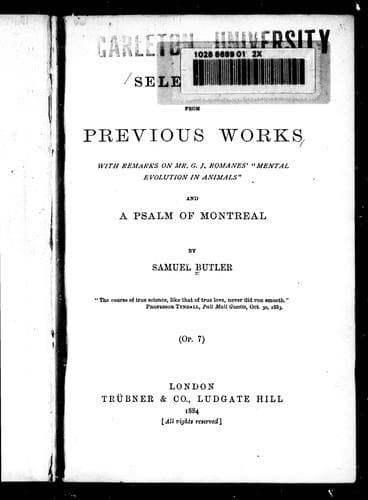
Selections from Previous Works: With Remarks on Romanes' Mental Evolution in Animals, and a Psalm of MontrealButler, Samuel
Philosophy
Selections from Previous Works: With Remarks on Romanes' Mental Evolution in Animals, and a Psalm of Montreal
Butler, Samuel
English literature -- 19th century -- Miscellanea; Romanes, George John, 1848-1894. Mental evolution in animals
The so-called man of science, on the other hand, seems now generally
inclined to make light of all knowledge, save of the pioneer character.
His ideal is in self-conscious knowledge. Let us have no more Lo, here,
with the professor; he very rarely knows what he says he knows; no sooner
has he misled the world for a sufficient time with a great flourish of
trumpets than he is toppled over by one more plausible than himself. He
is but medicine-man, augur, priest, in its latest development; useful it
may be, but requiring to be well watched by those who value freedom. Wait
till he has become more powerful, and note the vagaries which his conceit
of knowledge will indulge in. The Church did not persecute while she was
still weak. Of course every system has had, and will have, its heroes,
but, as we all very well know, the heroism of the hero is but remotely
due to system; it is due not to arguments, nor reasoning, nor to any
consciously recognised perceptions, but to those deeper sciences which
lie far beyond the reach of self-analysis, and for the study of which
there is but one schooling--to have had good forefathers for many
generations.
Above all things let no unwary reader do me the injustice of believing in
_me_. In that I write at all I am among the damned. If he must believe
in anything, let him believe in the music of Handel, the painting of
Giovanni Bellini, and in the thirteenth chapter of St. Paul's First
Epistle to the Corinthians.
But to return. Whenever we find people knowing that they know this or
that, we have the same story over and over again. They do not yet know
it perfectly.
We come, therefore, to the conclusion that our knowledge and reasonings
thereupon, only become perfect, assured, unhesitating, when they have
become automatic, and are thus exercised without further conscious effort
of the mind, much in the same way as we cannot walk nor read nor write
perfectly till we can do so automatically.
APPLICATION OF FOREGOING CHAPTERS TO CERTAIN HABITS ACQUIRED AFTER BIRTH
WHICH ARE COMMONLY CONSIDERED INSTINCTIVE. (CHAPTER III. OF LIFE AND
HABIT.)
What is true of knowing is also true of willing. The more intensely we
will, the less is our will deliberate and capable of being recognised as
will at all. So that it is common to hear men declare under certain
circumstances that they had no will, but were forced into their own
action under stress of passion or temptation. But in the more ordinary
actions of life, we observe, as in walking or breathing, that we do not
will anything utterly and without remnant of hesitation, till we have
lost sight of the fact that we are exercising our will.
Public-domain text, read in full here on John Shaqi.
Reviews
Reviews
No reviews yet
Be the first to share your thoughts on this work.
Join the Discussion
Join the discussion
Sign in to leave a comment or review.
Sign InorCreate an account