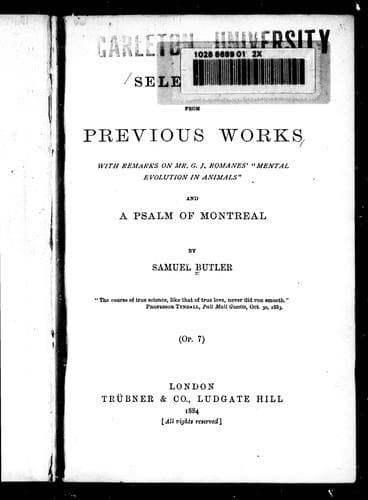
Selections from Previous Works: With Remarks on Romanes' Mental Evolution in Animals, and a Psalm of MontrealButler, Samuel
Philosophy
Selections from Previous Works: With Remarks on Romanes' Mental Evolution in Animals, and a Psalm of Montreal
Butler, Samuel
English literature -- 19th century -- Miscellanea; Romanes, George John, 1848-1894. Mental evolution in animals
The question, therefore, is forced upon us, how far this principle
extends, and whether there may not be unheeded examples of its operation
which, if we consider them, will land us in rather unexpected
conclusions. If it be granted that consciousness of knowledge and of
volition vanishes when the knowledge and the volition have become intense
and perfect, may it not be possible that many actions which we do without
knowing how we do them, and without any conscious exercise of the
will--actions which we certainly could not do if we tried to do them, nor
refrain from doing if for any reason we wished to do so--are done so
easily and so unconsciously owing to excess of knowledge or experience
rather than deficiency, we having done them too often, knowing how to do
them too well, and having too little hesitation as to the method of
procedure, to be capable of following our own action, without the
derangement of such action altogether; or, in other cases, because we
have so long settled the question that we have stowed away the whole
apparatus with which we work in corners of our system which we cannot now
conveniently reach?
It may be interesting to see whether we can find any class or classes of
actions which link actions which for some time after birth we could not
do at all, and in which our proficiency has reached the stage of
unconscious performance obviously through repeated effort and failure,
and through this only, with actions which we could do as soon as we were
born, and concerning which it would at first sight appear absurd to say
that they can have been acquired by any process in the least analogous to
what we commonly call experience, inasmuch as the creature itself which
does them has only just begun to exist, and cannot, therefore, in the
very nature of things, have had experience.
Can we see that actions, for the acquisition of which experience is such
an obvious necessity, that whenever we see the acquisition we assume the
experience, gradate away imperceptibly into actions which seem, according
to all reasonable analogy, to necessitate experience--of which, however,
the time and place are so obscure, that they are not now commonly
supposed to have any connection with _bona fide_ experience at all.
Public-domain text, read in full here on John Shaqi.
Reviews
Reviews
No reviews yet
Be the first to share your thoughts on this work.
Join the Discussion
Join the discussion
Sign in to leave a comment or review.
Sign InorCreate an account