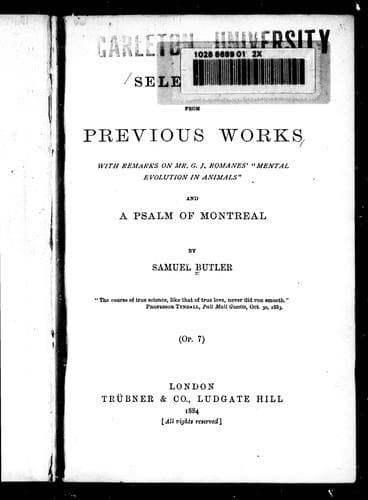
Selections from Previous Works: With Remarks on Romanes' Mental Evolution in Animals, and a Psalm of MontrealButler, Samuel
Philosophy
Selections from Previous Works: With Remarks on Romanes' Mental Evolution in Animals, and a Psalm of Montreal
Butler, Samuel
English literature -- 19th century -- Miscellanea; Romanes, George John, 1848-1894. Mental evolution in animals
Eating and drinking appear to be such actions. The new-born child cannot
eat, and cannot drink, but he can swallow as soon as he is born; and
swallowing appears (as we may remark in passing) to have been an earlier
faculty of animal life than that of eating with teeth. The ease and
unconsciousness with which we eat and drink is clearly attributable to
practice; but a very little practice seems to go a long way--a
suspiciously small amount of practice--as though somewhere or at some
other time there must have been more practice than we can account for. We
can very readily stop eating or drinking, and can follow our own action
without difficulty in either process; but as regards swallowing, which is
the earlier habit, we have less power of self-analysis and control: when
we have once committed ourselves beyond a certain point to swallowing, we
must finish doing so,--that is to say, our control over the operation
ceases. Also, a still smaller experience seems necessary for the
acquisition of the power to swallow than appeared necessary in the case
of eating; and if we get into a difficulty we choke, and are more at a
loss how to become introspective than we are about eating and drinking.
Why should a baby be able to swallow--which one would have said was the
more complicated process of the two--with so much less practice than it
takes him to learn to eat? How comes it that he exhibits in the case of
the more difficult operation all the phenomena which ordinarily accompany
a more complete mastery and longer practice? Analogy points in the
direction of thinking that the necessary experience cannot have been
wanting, and that, too, not in such a quibbling sort as when people talk
about inherited habit or the experience of the race, which, without
explanation, is to plain-speaking persons very much the same, in regard
to the individual, as no experience at all, but _bona fide_ in the
child's own person.
Breathing, again, is an action acquired after birth, generally with some
little hesitation and difficulty, but still acquired in a time seldom
longer, as I am informed, than ten minutes or a quarter of an hour. For
an art which has to be acquired at all, there seems here, as in the case
of eating, to be a disproportion between, on the one hand, the intricacy
of the process performed, and on the other, the shortness of the time
taken to acquire the practice, and the ease and unconsciousness with
which its exercise is continued from the moment of acquisition.
Public-domain text, read in full here on John Shaqi.
Reviews
Reviews
No reviews yet
Be the first to share your thoughts on this work.
Elsewhere in the archive
Join the Discussion
Join the discussion
Sign in to leave a comment or review.
Sign InorCreate an account