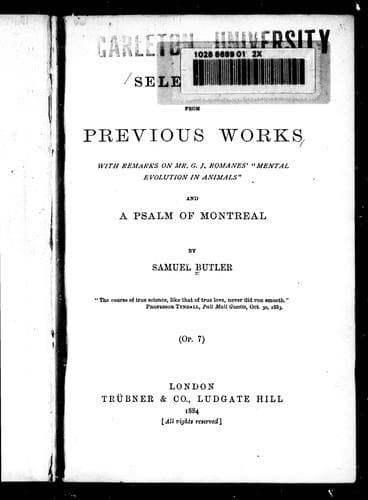
Selections from Previous Works: With Remarks on Romanes' Mental Evolution in Animals, and a Psalm of MontrealButler, Samuel
Philosophy
Selections from Previous Works: With Remarks on Romanes' Mental Evolution in Animals, and a Psalm of Montreal
Butler, Samuel
English literature -- 19th century -- Miscellanea; Romanes, George John, 1848-1894. Mental evolution in animals
It has been said a day will come when the Polar ice shall have
accumulated, till it forms vast continents many thousands of feet above
the level of the sea, all of solid ice. The weight of this mass will, it
is believed, cause the world to topple over on its axis, so that the
earth will be upset as an ant-heap overturned by a ploughshare. In that
day the icebergs will come crunching against our proudest cities, razing
them from off the face of the earth as though they were made of rotten
blotting-paper. There is no respect now of Handel nor of Shakespeare;
the works of Rembrandt and Bellini fossilise at the bottom of the sea.
Grace, beauty, and wit, all that is precious in music, literature, and
art--all gone. In the morning there was Europe. In the evening there
are no more populous cities nor busy hum of men, but a sea of jagged ice,
a lurid sunset, and the doom of many ages. Then shall a scared remnant
escape in places, and settle upon the changed continent when the waters
have subsided--a simple people, busy hunting shellfish on the drying
ocean beds, and with little time for introspection; yet they can read and
write and sum, for by that time these accomplishments will have become
universal, and will be acquired as easily as we now learn to talk; but
they do so as a matter of course, and without self-consciousness. Also
they make the simpler kinds of machinery too easily to be able to follow
their own operations--the manner of their own apprenticeship being to
them as a buried city. May we not imagine that, after the lapse of
another ten thousand years or so, some one of them may again become
cursed with lust of introspection, and a second Harvey may astonish the
world by discovering that it can read and write, and that steam-engines
do not grow, but are made? It may be safely prophesied that he will die
a martyr, and be honoured in the fourth generation.
PERSONAL IDENTITY. (CHAPTER V. OF LIFE AND HABIT.)
"Strange difficulties have been raised by some," says Bishop Butler,
"concerning personal identity, or the sameness of living agents as
implied in the notion of our existing now and hereafter, or indeed in any
two consecutive moments." But in truth it is not easy to see the
strangeness of the difficulty, if the words either "personal" or
"identity" are used in any strictness.
Public-domain text, read in full here on John Shaqi.
Reviews
Reviews
No reviews yet
Be the first to share your thoughts on this work.
Elsewhere in the archive
Join the Discussion
Join the discussion
Sign in to leave a comment or review.
Sign InorCreate an account