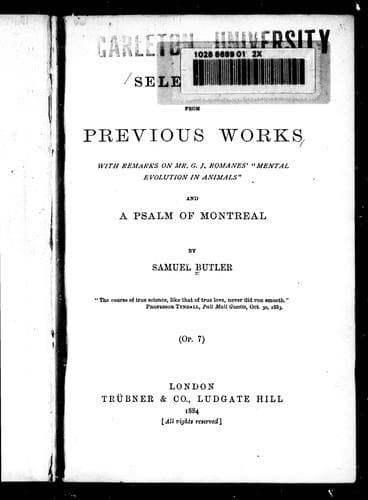
Selections from Previous Works: With Remarks on Romanes' Mental Evolution in Animals, and a Psalm of MontrealButler, Samuel
Philosophy
Selections from Previous Works: With Remarks on Romanes' Mental Evolution in Animals, and a Psalm of Montreal
Butler, Samuel
English literature -- 19th century -- Miscellanea; Romanes, George John, 1848-1894. Mental evolution in animals
Common parlance, however, settles the difficulty readily enough (as
indeed it settles most others if they show signs of awkwardness) by the
simple process of ignoring it: we decline, and very properly, to go into
the question of where personality begins and ends, but assume it to be
known by every one, and throw the onus of not knowing it upon the over-
curious, who had better think as their neighbours do, right or wrong, or
there is no knowing into what villany they may not presently fall.
Assuming, then, that every one knows what is meant by the word "person"
(and such superstitious bases as this are the foundations upon which all
action, whether of man, beast, or plant, is constructed and rendered
possible; for even the corn in the fields grows upon a superstitious
basis as to its own existence, and only turns the earth and moisture into
wheat through the conceit of its own ability to do so, without which
faith it were powerless; and the lichen only grows upon the granite rock
by first saying to itself, "I think I can do it;" so that it would not be
able to grow unless it thought it could grow, and would not think it
could grow unless it found itself able to grow, and thus spends its life
arguing most virtuously in a most vicious circle--basing action upon
hypothesis, which hypothesis is in turn based upon action)--assuming that
we know what is meant by the word "person," we say that we are one and
the same person from birth till death, so that whatever is done by or
happens to any one between birth and death, is said to happen to or be
done by one individual. This in practice is found sufficient for the law
courts and the purposes of daily life, which, being full of hurry and the
pressure of business, can only tolerate compromise, or conventional
rendering of intricate phenomena. When facts of extreme complexity have
to be daily and hourly dealt with by people whose time is money, they
must be simplified, and treated much as a painter treats them, drawing
them in squarely, seizing the more important features, and neglecting all
that does not assert itself as too essential to be passed over--hence the
slang and cant words of every profession, and indeed all language; for
language at best is but a kind of "patter," the only way, it is true, in
many cases, of expressing our ideas to one another, but still a very bad
way, and not for one moment comparable to the unspoken speech which we
may sometimes have recourse to. The metaphors and _facons de parler_ to
which even in the plainest speech we are perpetually recurring (as, for
example, in this last two lines, "plain," "perpetually," and "recurring,"
are all words based on metaphor, and hence more or less liable to
mislead) often deceive us, as though there were nothing more than what we
see and say, and as though words, instead of being, as they are, the
creatures of our convenience, had some claim to be the actual ideas
themselves concerning which we are conversing.
Public-domain text, read in full here on John Shaqi.
Reviews
Reviews
No reviews yet
Be the first to share your thoughts on this work.
Elsewhere in the archive
Join the Discussion
Join the discussion
Sign in to leave a comment or review.
Sign InorCreate an account