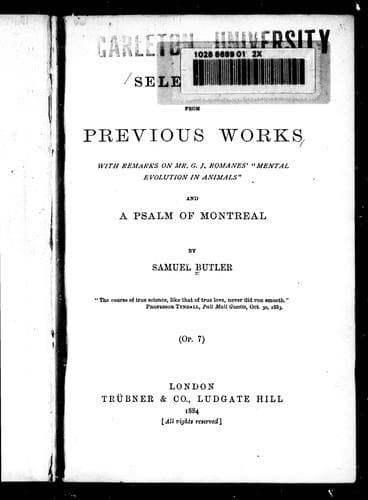
Selections from Previous Works: With Remarks on Romanes' Mental Evolution in Animals, and a Psalm of MontrealButler, Samuel
Philosophy
Selections from Previous Works: With Remarks on Romanes' Mental Evolution in Animals, and a Psalm of Montreal
Butler, Samuel
English literature -- 19th century -- Miscellanea; Romanes, George John, 1848-1894. Mental evolution in animals
The fencing (for it does not deserve the name of serious disputation)
with which Bishop Butler meets his opponents is rendered possible by the
laxness with which the words "identical" and "identity" are ordinarily
used. Bishop Butler would not seriously deny that personality undergoes
great changes between infancy and old age, and hence that it must undergo
some change from moment to moment. So universally is this recognised,
that it is common to hear it said of such and such a man that he is not
at all the person he was, or of such and such another that he is twice
the man he used to be--expressions than which none nearer the truth can
well be found. On the other hand, those whom Bishop Butler is intending
to confute would be the first to admit that, though there are many
changes between infancy and old age, yet they come about in any one
individual under such circumstances as we are all agreed in considering
as the factors of personal identity rather than as hindrances
thereto--that is to say that there has been no entire and permanent death
on the part of the individual between any two phases of his existence,
and that any one phase has had a lasting though perhaps imperceptible
effect upon all succeeding ones. So that no one ever seriously argued in
the manner supposed by Bishop Butler, unless with modifications and
saving clauses, to which it does not suit his purpose to call attention.
* * * * *
No doubt it would be more strictly accurate to say "you are the now phase
of the person I met last night," or "you are the being which has been
evolved from the being I met last night," than "you are the person I met
last night." But life is too short for the periphrases which would crowd
upon us from every quarter, if we did not set our face against all that
is under the surface of things, unless, that is to say, the going beneath
the surface is, for some special chance of profit, excusable or capable
of extenuation.
* * * * *
Public-domain text, read in full here on John Shaqi.
Reviews
Reviews
No reviews yet
Be the first to share your thoughts on this work.
Elsewhere in the archive
Join the Discussion
Join the discussion
Sign in to leave a comment or review.
Sign InorCreate an account