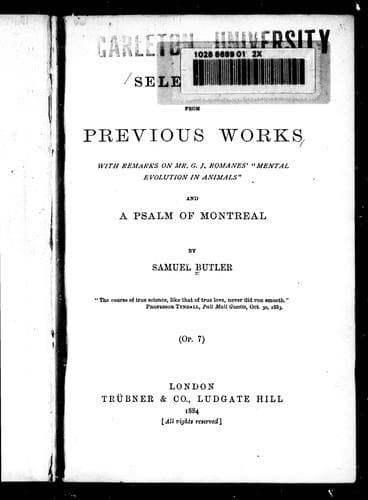
Selections from Previous Works: With Remarks on Romanes' Mental Evolution in Animals, and a Psalm of MontrealButler, Samuel
Philosophy
Selections from Previous Works: With Remarks on Romanes' Mental Evolution in Animals, and a Psalm of Montreal
Butler, Samuel
English literature -- 19th century -- Miscellanea; Romanes, George John, 1848-1894. Mental evolution in animals
But every instinct must have passed through the laboriously intelligent
stages through which human civilisations _and mechanical inventions_ are
now passing; and he who would study the origin of an instinct with its
development, partial transmission, further growth, further transmission,
approach to more unreflecting stability, and finally, its perfection as
an unerring and unerringly transmitted instinct, must look to laws,
customs, _and machinery_ as his best instructors. Customs and machines
are instincts _and organs_ now in process of development; they will
assuredly one day reach the unconscious state of equilibrium which we
observe in the structures and instincts of bees and ants, and an approach
to which may be found among some savage nations. We may reflect,
however, not without pleasure, that this condition--the true
millennium--is still distant. Nevertheless the ants and bees seem happy;
perhaps more happy than when so many social questions were in as hot
discussion among them as other and not dissimilar ones will one day be
amongst ourselves.
And this, as will be apparent, opens up the whole question of the
stability of species, which we cannot follow further here, than to say,
that according to the balance of testimony, many plants and animals do
appear to have reached a phase of being from which they are hard to
move--that is to say, they will die sooner than be at the pains of
altering their habits--true martyrs to their convictions. Such races
refuse to see changes in their surroundings as long as they can, but when
compelled to recognise them, they throw up the game because they cannot
and will not, or will not and cannot, invent.
This is perfectly intelligible, for a race is nothing but a long-lived
individual, and like any individual, or tribe of men whom we have yet
observed, will have its special capacities and its special limitations,
though, as in the case of the individual, so also with the race, it is
exceedingly hard to say what those limitations are, and why, having been
able to go so far, it should go no further. Every man and every race is
capable of education up to a certain point, but not to the extent of
being made from a sow's ear into a silk purse. The proximate cause of
the limitation seems to lie in the absence of the wish to go further; the
presence or absence of the wish will depend upon the nature and
surroundings of the individual, which is simply a way of saying that one
can get no further, but that as the song (with a slight alteration)
says:--
"Some breeds do, and some breeds don't,
Some breeds will, but this breed won't:
I tried very often to see if it would,
But it said it really couldn't, and I don't think it could."
* * * * *
Public-domain text, read in full here on John Shaqi.
Reviews
Reviews
No reviews yet
Be the first to share your thoughts on this work.
Elsewhere in the archive
Join the Discussion
Join the discussion
Sign in to leave a comment or review.
Sign InorCreate an account