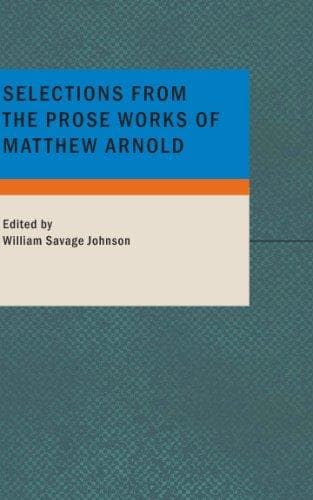
Selections from the Prose Works of Matthew ArnoldArnold, Matthew
General
Selections from the Prose Works of Matthew Arnold
Arnold, Matthew
English essays -- 19th century
Wordsworth deals with it, and his greatness lies in his dealing with it
so powerfully. I have named a number of celebrated poets above all of
whom he, in my opinion, deserves to be placed. He is to be placed above
poets like Voltaire, Dryden, Pope, Lessing, Schiller, because these
famous personages, with a thousand gifts and merits, never, or scarcely
ever, attain the distinctive accent and utterance of the high and
genuine poets--
"Quique pii vates et Phoebo digna locuti,"[375]
at all. Burns, Keats, Heine, not to speak of others in our list, have
this accent;--who can doubt it? And at the same time they have treasures
of humor, felicity, passion, for which in Wordsworth we shall look in
vain. Where, then, is Wordsworth's superiority? It is here; he deals
with more of _life_ than they do; he deals with _life_ as a whole, more
powerfully.
No Wordsworthian will doubt this. Nay, the fervent Wordsworthian will
add, as Mr. Leslie Stephen[376] does, that Wordsworth's poetry is
precious because his philosophy is sound; that his "ethical system is as
distinctive and capable of exposition as Bishop Butler's"; that his
poetry is informed by ideas which "fall spontaneously into a scientific
system of thought." But we must be on our guard against the
Wordsworthians, if we want to secure for Wordsworth his due rank as a
poet. The Wordsworthians are apt to praise him for the wrong things, and
to lay far too much stress upon what they call his philosophy. His
poetry is the reality, his philosophy--so far, at least, as it may put
on the form and habit of "a scientific system of thought," and the more
that it puts them on--is the illusion. Perhaps we shall one day learn to
make this proposition general, and to say: Poetry is the reality,
philosophy the illusion. But in Wordsworth's case, at any rate, we
cannot do him justice until we dismiss his formal philosophy.
The _Excursion_ abounds with philosophy and therefore the _Excursion_ is
to the Wordsworthian what it never can be to the disinterested lover of
poetry,--a satisfactory work. "Duty exists," says Wordsworth, in the
_Excursion_; and then he proceeds thus--
" ... Immutably survive,
For our support, the measures and the forms,
Which an abstract Intelligence supplies,
Whose kingdom is, where time and space are not."[377]
And the Wordsworthian is delighted, and thinks that here is a sweet
union of philosophy and poetry. But the disinterested lover of poetry
will feel that the lines carry us really not a step farther than the
proposition which they would interpret; that they are a tissue of
elevated but abstract verbiage, alien to the very nature of poetry.
Or let us come direct to the centre of Wordsworth's philosophy, as "an
ethical system, as distinctive and capable of systematical exposition as
Bishop Butler's"--
Public-domain text, read in full here on John Shaqi.
Reviews
Reviews
No reviews yet
Be the first to share your thoughts on this work.
Elsewhere in the archive
Join the Discussion
Join the discussion
Sign in to leave a comment or review.
Sign InorCreate an account