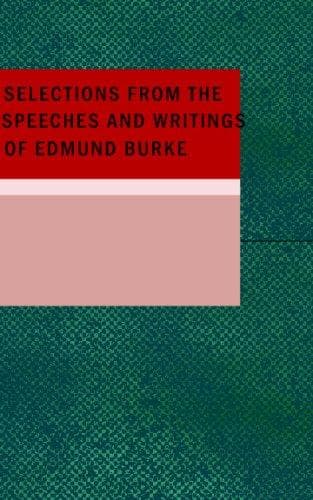
Selections from the Speeches and Writings of Edmund BurkeBurke, Edmund
Philosophy
Selections from the Speeches and Writings of Edmund Burke
Burke, Edmund
Burke, Edmund, 1729-1797; Essays; Political science; Speeches, addresses, etc.
It is not worth our while to discuss, like sophisters, whether, in
no case, some evil, for the sake of some benefit, is to be tolerated.
Nothing universal can be rationally affirmed on any moral or any
political subject. Pure metaphysical abstraction does not belong
to these matters. The lines of morality are not like ideal lines of
mathematics. They are broad and deep as well as long. They admit
of exceptions; they demand modifications. These exceptions and
modifications are not made by the process of logic, but by the rules
of prudence. Prudence is not only the first in rank of the virtues
political and moral, but she is the director, the regulator, the
standard of them all. Metaphysics cannot live without definition; but
prudence is cautious how she defines. Our courts cannot be more fearful
in suffering fictitious cases to be brought before them for eliciting
their determination on a point of law, than prudent moralists are in
putting extreme and hazardous cases of conscience upon emergencies not
existing. Without attempting therefore to define, what never can be
defined, the case of a revolution in government, this, I think, may be
safely affirmed, that a sore and pressing evil is to be removed, and
that a good, great in its amount, and unequivocal in its nature, must
be probable almost to certainty, before the inestimable price of our own
morals, and the well-being of a number of our fellow-citizens, is paid
for a revolution. If ever we ought to be economists even to parsimony,
it is in the voluntary production of evil. Every revolution contains in
it something of evil.
APPEAL TO IMPARTIALITY.
The quality of the sentence does not however decide on the justice of
it. Angry friendship is sometimes as bad as calm enmity. For this reason
the cold neutrality of abstract justice is, to a good and clear cause,
a more desirable thing than an affection liable to be any way disturbed.
When the trial is by friends, if the decision should happen to be
favourable, the honour of the acquittal is lessened; if adverse, the
condemnation is exceedingly embittered. It is aggravated by coming from
lips professing friendship, and pronouncing judgment with sorrow and
reluctance. Taking in the whole view of life, it is more safe to live
under the jurisdiction of severe but steady reason, than under the
empire of indulgent but capricious passion. It is certainly well for
Mr. Burke that there are impartial men in the world. To them I address
myself, pending the appeal which on his part is made from the living to
the dead, from the modern Whigs to the ancient.
HISTORICAL ESTIMATE OF LOUIS XVI.
Public-domain text, read in full here on John Shaqi.
Reviews
Reviews
No reviews yet
Be the first to share your thoughts on this work.
Elsewhere in the archive
Join the Discussion
Join the discussion
Sign in to leave a comment or review.
Sign InorCreate an account